Champagne, Duane Editor
Biography not available.

Browse all FOLKLORE books
Browse all GARDENS books
Browse all GRAPHIC NOVELS books
Browse all HISTORY - MEDIEVAL books
Browse all HUMOUR books
Browse all Juvenile Fiction : Biographical - Other books
Browse all Juvenile Fiction : Historical - Other books
Browse all Juvenile Fiction : Legends, Myths, & Fables - Other books
Browse all Juvenile Fiction : People & Places - Other books
Browse all Juvenile Fiction : People & Places - United States - Other books
Browse all Juvenile Fiction : Religious - Other books
Browse all Juvenile Nonfiction : History - Other books
Browse all Juvenile Nonfiction : Mathematics - Advanced books
Browse all Juvenile Nonfiction : People & Places - Other books
Browse all Juvenile Nonfiction : People & Places - United States - Othe books
Browse all LITERARY STUDIES books
Browse all LONDON books
Browse all Medical : Nursing - Mental Health books
Browse all MIND books
Browse all MUSEOLOGY books
Browse all NON-CLASSIFIABLE books
Browse all NONLINEAR SCIENCE books
Browse all POPULAR SCIENCE books
Browse all RELIGIOUS STUDIES books
Browse all SPIRIT books
Browse all SPORT books
Browse all TRAVEL WRITING books
 Out of Stock
NATIVE AMER STUDIES IN HIGHER
Paperback · ISBN 9780759101258
Inclusive of GST and other taxes
Arriving at your doorstep in 10-15 days
Our logisitcs team will make sure everyitem is delivered safely
| ISBN | 9780759101258 |
|---|---|
| Subtitle | NATIVE AMER STUDIES IN HIGHER |
| Publisher | AltaMira Press |
| Publication date | March 2002 |
| Language | English |
| MRP | £41.99 GBP |
| Page count | 256 |
| Item weight | 84 g |
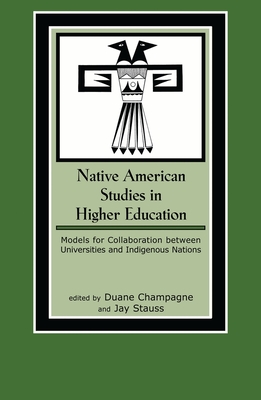
In this collection, Champagne and Stauss demonstrate how the rise of Native studies in American and Canadian universities exists as an extraordinary achievement in higher education. In the face of historically assimilationist agendas, institutional racism, and structural opposition by Western educational institutions, collaborative programs continue to grow and promote the values and goals of sovereign tribal communities. The contributors show how many departments grew significantly following the landmark 1969 Senate report, 'Indian Education: A National Tragedy, A National Challenge.' They evaluate the university efforts to offer Native students intellectual and technical skills, and the long battle to represent Native cultures and world views in the university curriculum. In twelve case studies, Indian and non-Indian teachers provide rich, contextual histories of their programs through three decades of growth. They frankly discuss successes and failures as innovative strategies and models are tested. Programs from University of California-Davis, Harvard, Saskatchewan, Arizona and others provide detailed analyses of academic battles over curriculum content, the marginalization of indigenous faculty and students, the pedagogical implications of integrating native instructors, the vagaries of administrative support and funding, Native student retention, the vulnerability of native language programs, and community collaborations. A vision of Indian education that emerges from these pages that reveals the university's potential as a vehicle for Indian nation-building, one in which the university curriculum also benefits from sustained contacts with tribal communities. As Native populations grow and the demand for university training increases, this book will be a valuable resource for Native American leaders, educators in Native American studies, race and ethnic studies, comparative education, minorities in education, anthropology, sociology, higher education administration and educational policy.
Log in to write a review for this book.
No reviews yet. Be the first to share your opinion.
Biography not available.
Biography not available.
Biography not available.