Duraiappah, A.K. Author
Biography not available.

Browse all FOLKLORE books
Browse all GARDENS books
Browse all GRAPHIC NOVELS books
Browse all HISTORY - MEDIEVAL books
Browse all HUMOUR books
Browse all Juvenile Fiction : Biographical - Other books
Browse all Juvenile Fiction : Historical - Other books
Browse all Juvenile Fiction : Legends, Myths, & Fables - Other books
Browse all Juvenile Fiction : People & Places - Other books
Browse all Juvenile Fiction : People & Places - United States - Other books
Browse all Juvenile Fiction : Religious - Other books
Browse all Juvenile Nonfiction : History - Other books
Browse all Juvenile Nonfiction : Mathematics - Advanced books
Browse all Juvenile Nonfiction : People & Places - Other books
Browse all Juvenile Nonfiction : People & Places - United States - Othe books
Browse all LITERARY STUDIES books
Browse all LONDON books
Browse all Medical : Nursing - Mental Health books
Browse all MIND books
Browse all MUSEOLOGY books
Browse all NON-CLASSIFIABLE books
Browse all NONLINEAR SCIENCE books
Browse all POPULAR SCIENCE books
Browse all RELIGIOUS STUDIES books
Browse all SPIRIT books
Browse all SPORT books
Browse all TRAVEL WRITING books
 Out of Stock
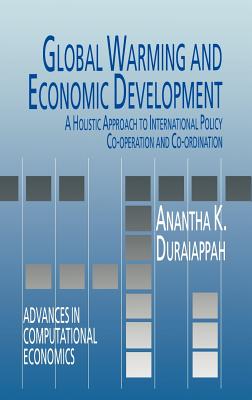
GLOBAL WARMING & ECONOMIC DEVE
Hardback · ISBN 9780792321491
Inclusive of GST and other taxes
Arriving at your doorstep in 10-15 days
Our logisitcs team will make sure everyitem is delivered safely
| ISBN | 9780792321491 |
|---|---|
| Subtitle | GLOBAL WARMING & ECONOMIC DEVE |
| Publisher | Springer |
| Publication date | April 1993 |
| Language | English |
| MRP | £89.99 GBP |
| Page count | 248 |
| Item weight | 116 g |
The computer revolution both in the hardware as well as in software has made it possible for economists to analyze complex issues which could not be solved in the past by analytical methods. A large library of numerical techniques are now available to economists for solving models ranging from a simple system of linear simultaneous equations to large non-linear dynamic optimization models. We attempt to take advantage of these advancements in computational economics to address the issue of global warming and economic development. The use of computer simulation models has enhanced the understanding of some of the underlying issues in the global warming literature which would have been impossible without these models. However, to date, the global warming issue has been addressed in a partial equilibrium framework. In other words, the climate scientists tend to specify economic variables as exogenous variables in their global warming models while the economists do the same by specifying the climate variables as exogenous variables in their global warming models. Both approaches ignore important feedback relationships which will be triggered when either economic or climate variables are perturbed. The ideal model structure would be one in which both systems are incorporated within one framework with emphasis on the long run effects of greenhouse gas curbing policies and the corresponding effect on the economic growth potential of the economies.
Log in to write a review for this book.
No reviews yet. Be the first to share your opinion.
Biography not available.