By, Rolf A. de Author
Biography not available.

Browse all FOLKLORE books
Browse all GARDENS books
Browse all GRAPHIC NOVELS books
Browse all HISTORY - MEDIEVAL books
Browse all HUMOUR books
Browse all Juvenile Fiction : Biographical - Other books
Browse all Juvenile Fiction : Historical - Other books
Browse all Juvenile Fiction : Legends, Myths, & Fables - Other books
Browse all Juvenile Fiction : People & Places - Other books
Browse all Juvenile Fiction : People & Places - United States - Other books
Browse all Juvenile Fiction : Religious - Other books
Browse all Juvenile Nonfiction : History - Other books
Browse all Juvenile Nonfiction : Mathematics - Advanced books
Browse all Juvenile Nonfiction : People & Places - Other books
Browse all Juvenile Nonfiction : People & Places - United States - Othe books
Browse all LITERARY STUDIES books
Browse all LONDON books
Browse all Medical : Nursing - Mental Health books
Browse all MIND books
Browse all MUSEOLOGY books
Browse all NON-CLASSIFIABLE books
Browse all NONLINEAR SCIENCE books
Browse all POPULAR SCIENCE books
Browse all RELIGIOUS STUDIES books
Browse all SPIRIT books
Browse all SPORT books
Browse all TRAVEL WRITING books
 Out of Stock
TRANSACTION MGMT SUPPORT FOR C
Hardback · ISBN 9780792381006
Inclusive of GST and other taxes
Arriving at your doorstep in 10-15 days
Our logisitcs team will make sure everyitem is delivered safely
| ISBN | 9780792381006 |
|---|---|
| Subtitle | TRANSACTION MGMT SUPPORT FOR C |
| Publisher | Springer |
| Publication date | December 1997 |
| Language | English |
| MRP | £129.99 GBP |
| Page count | 244 |
| Item weight | 115 g |
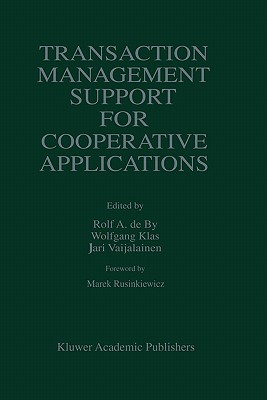
Transaction Management Support for Cooperative Application is a comprehensive report on a successful international project, called TRANSCOOP, carried out from 1994 to 1997 by a group of European scientists. But the book is also much more than that, namely, an ambitious attempt to integrate Computer-Supported Cooperative Work (CSCW), Workflow Management Systems (WFMS), and Transaction Processing (TP) technologies. The very term {\em cooperative transactions} is in itself contradictory. Cooperation technologies, such as CSCW, aim at providing a framework for information exchange between cooperating (human) participants. In contrast, traditional transaction technologies allow concurrent users to operate on shared data, while providing them with the illusion of complete isolation from each other. To overcome this contradiction, the TRANSCOOP researchers had to come up with a new and original notion of correctness of concurrent executions, based on controlled exchange of information between concurrent users. Merging histories in accordance with prespecified commutativity rules among concurrent operations provides transactional guarantees to activities such as cooperative designing, which until now had to be carried out sequentially. As an interesting consequence, it also provides a basis for management of consistency between disconnected or mobile users who operate independently and yet, must occasionally reconcile their work with each other.
Log in to write a review for this book.
No reviews yet. Be the first to share your opinion.
Biography not available.
Biography not available.
Biography not available.