Frantz, Roger Author
Biography not available.

Browse all FOLKLORE books
Browse all GARDENS books
Browse all GRAPHIC NOVELS books
Browse all HISTORY - MEDIEVAL books
Browse all HUMOUR books
Browse all Juvenile Fiction : Biographical - Other books
Browse all Juvenile Fiction : Historical - Other books
Browse all Juvenile Fiction : Legends, Myths, & Fables - Other books
Browse all Juvenile Fiction : People & Places - Other books
Browse all Juvenile Fiction : People & Places - United States - Other books
Browse all Juvenile Fiction : Religious - Other books
Browse all Juvenile Nonfiction : History - Other books
Browse all Juvenile Nonfiction : Mathematics - Advanced books
Browse all Juvenile Nonfiction : People & Places - Other books
Browse all Juvenile Nonfiction : People & Places - United States - Othe books
Browse all LITERARY STUDIES books
Browse all LONDON books
Browse all Medical : Nursing - Mental Health books
Browse all MIND books
Browse all MUSEOLOGY books
Browse all NON-CLASSIFIABLE books
Browse all NONLINEAR SCIENCE books
Browse all POPULAR SCIENCE books
Browse all RELIGIOUS STUDIES books
Browse all SPIRIT books
Browse all SPORT books
Browse all TRAVEL WRITING books
 Out of Stock
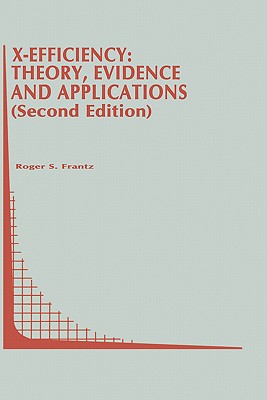
X-EFFICIENCY THEORY EVIDENCE &
Hardback · ISBN 9780792397687
Inclusive of GST and other taxes
Arriving at your doorstep in 10-15 days
Our logisitcs team will make sure everyitem is delivered safely
| ISBN | 9780792397687 |
|---|---|
| Subtitle | X-EFFICIENCY THEORY EVIDENCE & |
| Publisher | Springer |
| Publication date | May 1997 |
| Language | English |
| MRP | £89.99 GBP |
| Page count | 196 |
| Item weight | 100 g |
My interest in X-Efficiency (XE) dates back to 1978. At the time, I was writing the dissertation for my Ph. D. at Washington State University. My dissertation was concerned with the role of attitudes in the school-to-work transition among young men. I was advised by Professor Millard Hastay (a member of my committee) to look at Leibenstein's "new" book, Beyond Economic Man. One of the things that caught my attention was his behavioral description of (selective) rationality. It seemed that Leibenstein' s behavioral description of a (selectively) rational individ- ual was very similar to what psychologists such as Abraham Maslow were reporting as being the product of a particular motivational system. In other words, I was impressed with the idea that what Leibenstein was referring to as X-inefficiency was being discussed by psychologists as "the way it (often) is. " So from the beginning I always considered the concept ofX-(in)efficiency to be a valuable one for understanding human behavior. I have since come to believe that this is particularly true when considering behavior in non-market environments, i. e., within the firm. Work on this book, however, can most realistically said to have started with work which I began in 1982 while I was a Visiting Scholar at Harvard University. Professor Leibenstein suggested that I consider how some empirical evidence which was being cited as evidence for the role of property rights might also be consistent with XE theory. (The consistency, in both directions, is considerable.
Log in to write a review for this book.
No reviews yet. Be the first to share your opinion.
Biography not available.