Holland, Bart K. Author
Biography not available.

Browse all ART CRITICISM books
Browse all Ashworth books
Browse all FOLKLORE books
Browse all GARDENS books
Browse all GRAPHIC NOVELS books
Browse all Hamilton books
Browse all HISTORY - MEDIEVAL books
Browse all HUMOUR books
Browse all Juvenile Fiction : Biographical - Other books
Browse all Juvenile Fiction : Historical - Other books
Browse all Juvenile Fiction : Legends, Myths, & Fables - Other books
Browse all Juvenile Fiction : People & Places - Other books
Browse all Juvenile Fiction : People & Places - United States - Other books
Browse all Juvenile Fiction : Religious - Other books
Browse all Juvenile Nonfiction : History - Other books
Browse all Juvenile Nonfiction : Mathematics - Advanced books
Browse all Juvenile Nonfiction : People & Places - Other books
Browse all Juvenile Nonfiction : People & Places - United States - Othe books
Browse all KINDRED books
Browse all LITERARY STUDIES books
Browse all LONDON books
Browse all Lozada books
Browse all Medical : Nursing - Mental Health books
Browse all MIND books
Browse all MUSEOLOGY books
Browse all NON-CLASSIFIABLE books
Browse all NONLINEAR SCIENCE books
Browse all Ormonde books
Browse all POPULAR SCIENCE books
Browse all RELIGIOUS STUDIES books
Browse all SPIRIT books
Browse all SPORT books
Browse all TRAVEL WRITING books
 Out of Stock
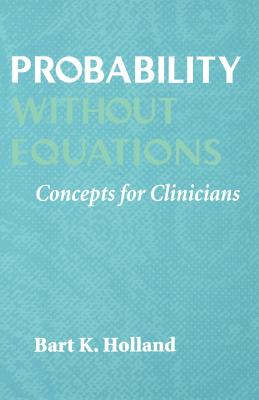
PROBABILITY W/O EQUATIONS
Paperback · ISBN 9780801857607
Inclusive of GST and other taxes
Arriving at your doorstep in 10-15 days
Our logisitcs team will make sure everyitem is delivered safely
| ISBN | 9780801857607 |
|---|---|
| Subtitle | PROBABILITY W/O EQUATIONS |
| Publisher | Johns Hopkins University Press |
| Publication date | December 1997 |
| Language | English |
| MRP | £25.50 GBP |
| Page count | 132 |
| Item weight | 39 g |
An award-winning teacher gives a non-technical explanation of the probability and statistics needed by physicians to interpret laboratory results.
Although few physicians, nurses, dentists, and other health professionals perform laboratory tests themselves, they all need to be able to interpret the results as well as understand findings reported in the medical literature. A general understanding of probability and statistics is essential for those needing to make daily decisions about the significance of research data, drug interaction precautions, or a patient's positive laboratory test for a rare disease.
Written with these needs in mind, Probability without Equations offers a thorough explanation of the subject without overwhelming the reader with equations and footnotes. Award-winning teacher Bart Holland presents a nontechnical treatment of intuitive concepts and presents numerous examples from medical research and practice. In plain language, this book explains the topics that clinicians need to understand:
- Analysis of variance
- "P-values" and the "t-test"
- Hazard models
- Regression and correlations
- Alpha and beta errors
"The Nobel prize-winning physicist Ernest Rutherford was fond of saying that if you need statistics to analyze the results of an experiment, you don't have a very good experiment. In a way he was right. However, a recurrent problem in medicine is that in a certain sense you commonly don't have a good experiment--but not because medical research scientists are generally incompetent! The nature of the data they work with is simply not as predictable as the data in some other fields, so the predictive nature of findings in medical science is generally rather imperfect."--from the introduction
Log in to write a review for this book.
No reviews yet. Be the first to share your opinion.
Biography not available.
Biography not available.
Biography not available.