Bardini, Thierry Author
Biography not available.

Browse all FOLKLORE books
Browse all GARDENS books
Browse all GRAPHIC NOVELS books
Browse all HISTORY - MEDIEVAL books
Browse all HUMOUR books
Browse all Juvenile Fiction : Biographical - Other books
Browse all Juvenile Fiction : Historical - Other books
Browse all Juvenile Fiction : Legends, Myths, & Fables - Other books
Browse all Juvenile Fiction : People & Places - Other books
Browse all Juvenile Fiction : People & Places - United States - Other books
Browse all Juvenile Fiction : Religious - Other books
Browse all Juvenile Nonfiction : History - Other books
Browse all Juvenile Nonfiction : Mathematics - Advanced books
Browse all Juvenile Nonfiction : People & Places - Other books
Browse all Juvenile Nonfiction : People & Places - United States - Othe books
Browse all LITERARY STUDIES books
Browse all LONDON books
Browse all Medical : Nursing - Mental Health books
Browse all MIND books
Browse all MUSEOLOGY books
Browse all NON-CLASSIFIABLE books
Browse all NONLINEAR SCIENCE books
Browse all POPULAR SCIENCE books
Browse all RELIGIOUS STUDIES books
Browse all SPIRIT books
Browse all SPORT books
Browse all TRAVEL WRITING books
 Out of Stock
Hardback · ISBN 9780804737234
Inclusive of GST and other taxes
Arriving at your doorstep in 10-15 days
Our logisitcs team will make sure everyitem is delivered safely
| ISBN | 9780804737234 |
|---|---|
| Publisher | Stanford University Press |
| Publication date | December 2000 |
| Language | English |
| MRP | £48.00 GBP |
| Page count | 314 |
| Item weight | 146 g |
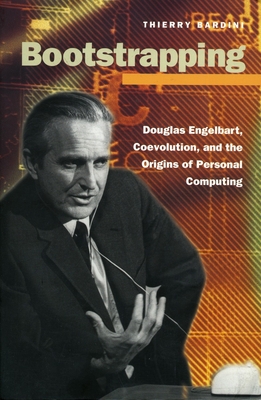
Bootstrapping analyzes the genesis of personal computing from both technological and social perspectives, through a close study of the pathbreaking work of one researcher, Douglas Engelbart. In his lab at the Stanford Research Institute in the 1960s, Engelbart, along with a small team of researchers, developed some of the cornerstones of personal computing as we know it, including the mouse, the windowed user interface, and hypertext. Today, all these technologies are well known, even taken for granted, but the assumptions and motivations behind their invention are not. Bootstrapping establishes Douglas Engelbart's contribution through a detailed history of both the material and the symbolic constitution of his system's human-computer interface in the context of the computer research community in the United States in the 1960s and 1970s.
Engelbart felt that the complexity of many of the world's problems was becoming overwhelming, and the time for solving these problems was becoming shorter and shorter. What was needed, he determined, was a system that would augment human intelligence, co-transforming or co-evolving both humans and the machines they use. He sought a systematic way to think and organize this coevolution in an effort to discover a path on which a radical technological improvement could lead to a radical improvement in how to make people work effectively. What was involved in Engelbart's project was not just the invention of a computerized system that would enable humans, acting together, to manage complexity, but the invention of a new kind of human, "the user." What he ultimately envisioned was a "bootstrapping" process by which those who actually invented the hardware and software of this new system would simultaneously reinvent the human in a new form.
The book also offers a careful narrative of the collapse of Engelbart's laboratory at Stanford Research Institute, and the further translation of Engelbart's vision. It shows that Engelbart's ultimate goal of coevolution came to be translated in terms of technological progress and human adaptation to supposedly user-friendly technologies. At a time of the massive diffusion of the World Wide Web, Bootstrapping recalls the early experiments and original ideals that led to today's "information revolution."
Log in to write a review for this book.
No reviews yet. Be the first to share your opinion.
Biography not available.