Lopez-Acevedo, Gladys Editor
Biography not available.

Browse all FOLKLORE books
Browse all GARDENS books
Browse all GRAPHIC NOVELS books
Browse all HISTORY - MEDIEVAL books
Browse all HUMOUR books
Browse all Juvenile Fiction : Biographical - Other books
Browse all Juvenile Fiction : Historical - Other books
Browse all Juvenile Fiction : Legends, Myths, & Fables - Other books
Browse all Juvenile Fiction : People & Places - Other books
Browse all Juvenile Fiction : People & Places - United States - Other books
Browse all Juvenile Fiction : Religious - Other books
Browse all Juvenile Nonfiction : History - Other books
Browse all Juvenile Nonfiction : Mathematics - Advanced books
Browse all Juvenile Nonfiction : People & Places - Other books
Browse all Juvenile Nonfiction : People & Places - United States - Othe books
Browse all LITERARY STUDIES books
Browse all LONDON books
Browse all Medical : Nursing - Mental Health books
Browse all MIND books
Browse all MUSEOLOGY books
Browse all NON-CLASSIFIABLE books
Browse all NONLINEAR SCIENCE books
Browse all POPULAR SCIENCE books
Browse all RELIGIOUS STUDIES books
Browse all SPIRIT books
Browse all SPORT books
Browse all TRAVEL WRITING books
 Out of Stock
SEWING SUCCESS
Paperback · ISBN 9780821387788
Inclusive of GST and other taxes
Arriving at your doorstep in 10-15 days
Our logisitcs team will make sure everyitem is delivered safely
| ISBN | 9780821387788 |
|---|---|
| Subtitle | SEWING SUCCESS |
| Publisher | World Bank Publications |
| Publication date | March 2012 |
| Language | English |
| MRP | £27.99 GBP |
| Page count | 532 |
| Item weight | 156 g |
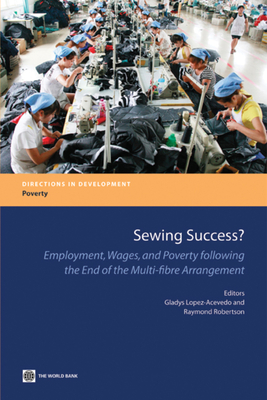
The end of the MFA was followed by rising apparel exports, falling prices, and a reallocation of production and employment between countries. There were also significant changes within countries. The first main finding of this report is that export and employment patterns after the MFA/ATC did not necessarily match predictions. While many predicted that production would shift to low-wage countries, this book shows that only 13 percent of variation in export changes post-MFA can be explained by the differences in wage levels. Second, changes in exports are usually, but not always, good indicators of what happens to wages and employment within countries. This is especially important for policy because it shows that simply using exports as a metric of 'success' in terms of helping the poor is not sufficient. Third, the Book identifies the specific ways that changes in the global apparel market affected earnings. The Book shows that wage premiums change in predictable ways: rising (in most cases) in countries that were proactive in adapting to the MFA phase-out and expanded their market shares, and falling in countries that failed to respond in a timely fashion to the changing environment. The Book shows that promoting 'upgrading' (defined as shifting to higher-value goods, shifting up the value chain, or 'modernizing' production techniques) seems to be necessary for sustainable competitiveness in the apparel sector but does not necessarily help the poor. Policies that support upgrading need to be complemented with targeted workforce development to make sure that the most vulnerable workers are not left behind. Having a vision for the evolution of the apparel sector that incorporates developing worker skills seems crucial. Otherwise, less-skilled workers could miss out on opportunities to gain valuable work experience in manufacturing.
Log in to write a review for this book.
No reviews yet. Be the first to share your opinion.
Biography not available.
Biography not available.