Dunnett, Stephen B. Editor
Biography not available.

Browse all ART CRITICISM books
Browse all Ashworth books
Browse all FOLKLORE books
Browse all GARDENS books
Browse all GRAPHIC NOVELS books
Browse all Hamilton books
Browse all HISTORY - MEDIEVAL books
Browse all HUMOUR books
Browse all Juvenile Fiction : Biographical - Other books
Browse all Juvenile Fiction : Historical - Other books
Browse all Juvenile Fiction : Legends, Myths, & Fables - Other books
Browse all Juvenile Fiction : People & Places - Other books
Browse all Juvenile Fiction : People & Places - United States - Other books
Browse all Juvenile Fiction : Religious - Other books
Browse all Juvenile Nonfiction : History - Other books
Browse all Juvenile Nonfiction : Mathematics - Advanced books
Browse all Juvenile Nonfiction : People & Places - Other books
Browse all Juvenile Nonfiction : People & Places - United States - Othe books
Browse all KINDRED books
Browse all LITERARY STUDIES books
Browse all LONDON books
Browse all Lozada books
Browse all Medical : Nursing - Mental Health books
Browse all MIND books
Browse all MUSEOLOGY books
Browse all NON-CLASSIFIABLE books
Browse all NONLINEAR SCIENCE books
Browse all Ormonde books
Browse all POPULAR SCIENCE books
Browse all RELIGIOUS STUDIES books
Browse all SPIRIT books
Browse all SPORT books
Browse all TRAVEL WRITING books
 Out of Stock
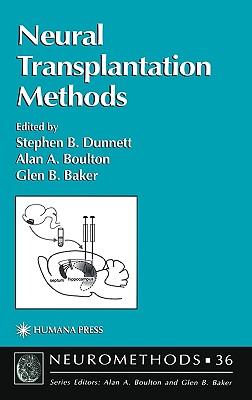
NEURAL TRANSPLANTATION METHODS
Hardback · ISBN 9780896037939
Inclusive of GST and other taxes
Arriving at your doorstep in 10-15 days
Our logisitcs team will make sure everyitem is delivered safely
| ISBN | 9780896037939 |
|---|---|
| Subtitle | NEURAL TRANSPLANTATION METHODS |
| Publisher | Humana Press |
| Publication date | October 1999 |
| Language | English |
| MRP | £129.99 GBP |
| Page count | 576 |
| Item weight | 216 g |
we might seek alternative sources of donor tissues. Genetic en- neering, expansion of precursor cells, generation of immortalized cell lines, and transplantation between species are all under active investigation. Although significant difficulties remain for each of these alternatives, the problems appear soluble and relevant knowledge is expanding rapidly. As we enter the twenty-first century, the place of neural tra- plantation in experimental neuroscience is continuing to evolve. Rather than being a topic in its own right, neural transplantation increasingly serves as just another technique in the researcher's armory--alongside lesions, pharmaceuticals, gene transfer, and a variety of other techniques--for the experimental manipulation of brain structure and function. This is particularly true for studies of degeneration, plasticity, regeneration, and recovery of function in the nervous system, topics of increasing importance as experimental neurobiology is required to serve the higher needs of neurological and mental health in aging societies. Within this evolving context, Neural Transplantation Methods seeks to serve a particular need: to provide experimental neu- scientists with a source book of information to enable them to select and adapt transplantation techniques to their own expe- mental programs. All authors have been asked to address prac- cal issues, to enable the reader to assess what is available, what are the alternatives, what are the practical issues to be resolved in applying a particular protocol and getting it to work reliably in their unique experimental context.
Log in to write a review for this book.
No reviews yet. Be the first to share your opinion.
Biography not available.
Biography not available.
Biography not available.