Riahi-Belkaoui, Ahmed Author
Biography not available.

Browse all ART CRITICISM books
Browse all Ashworth books
Browse all FOLKLORE books
Browse all GARDENS books
Browse all GRAPHIC NOVELS books
Browse all Hamilton books
Browse all HISTORY - MEDIEVAL books
Browse all HUMOUR books
Browse all Juvenile Fiction : Biographical - Other books
Browse all Juvenile Fiction : Historical - Other books
Browse all Juvenile Fiction : Legends, Myths, & Fables - Other books
Browse all Juvenile Fiction : People & Places - Other books
Browse all Juvenile Fiction : People & Places - United States - Other books
Browse all Juvenile Fiction : Religious - Other books
Browse all Juvenile Nonfiction : History - Other books
Browse all Juvenile Nonfiction : Mathematics - Advanced books
Browse all Juvenile Nonfiction : People & Places - Other books
Browse all Juvenile Nonfiction : People & Places - United States - Othe books
Browse all KINDRED books
Browse all LITERARY STUDIES books
Browse all LONDON books
Browse all Lozada books
Browse all Medical : Nursing - Mental Health books
Browse all MIND books
Browse all MUSEOLOGY books
Browse all NON-CLASSIFIABLE books
Browse all NONLINEAR SCIENCE books
Browse all Ormonde books
Browse all POPULAR SCIENCE books
Browse all RELIGIOUS STUDIES books
Browse all SPIRIT books
Browse all SPORT books
Browse all TRAVEL WRITING books
 Out of Stock
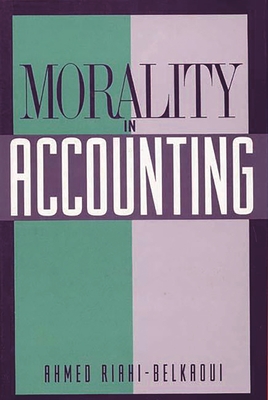
MORALITY IN ACCOUNTING
Hardback · ISBN 9780899307299
Inclusive of GST and other taxes
Arriving at your doorstep in 10-15 days
Our logisitcs team will make sure everyitem is delivered safely
| ISBN | 9780899307299 |
|---|---|
| Subtitle | MORALITY IN ACCOUNTING |
| Publisher | Praeger |
| Publication date | August 1992 |
| Language | English |
| MRP | £75.00 GBP |
| Page count | 224 |
| Item weight | 109 g |
Timely and reliable accounting information is essential. Not only firms themselves but the markets they serve, and particularly the investment community, depend on it. Accounting data and their interpretation must be above suspicion, says Riahi-Belkaoui, and to be sure of that, corporations and other users of accounting information must be certain that accountants subscribe to and practice morality set to high standards. What these standards are, and how they are deficient, distorted, and sometimes even fallacious, are the themes explored here. In doing so, Riahi-Belkaoui's book leads readers through the complexities of what the author identifies as the five aspects of accounting morality: fairness, ethics, honesty, social responsibility, and truth.
Riahi-Belkaoui begins with a discussion of fairness as a concept of justice, illustrated by the intellectual contributions of Rawls, Nozick, and Gerwith. From there he moves to ethics in accounting, and a review of such ethical perspectives as the utilitarian, the deontological, and the notion of fittingness. He also takes up the subject of ethical codes, and asks how do we discipline the accounting profession; then, how do we teach and research accounting ethics? Chapter 3 treats a variety of ethical issues and several key cases, among them the ESM Government Securities Case, the Drysdale Affair, and the Wedtech and Penn Square cases. In Chapter 4 Riahi-Belkaoui turns to honesty in the accounting environment and to discussions of the nature and framework of fraud, including what he calls outcome situations arising from corporate fraud. Chapter 5 explores the relationship between accounting and social responsibility, and makes clear that there is a need for an effective paradigm to define and help implement a socially responsible accounting. Finally, in Chapter 6 he comes to grips with the problem of truth in accounting--first, the notion of truth, then the impossibilities as well as the possibilities of attaining it. Morality in Accounting will be of special value to the producers and users of accounting, and to graduate and undergraduate students of the accounting discipline.
Log in to write a review for this book.
No reviews yet. Be the first to share your opinion.
Biography not available.