Badiru, Adedeji Bodunde Author
Biography not available.

Browse all ART CRITICISM books
Browse all Ashworth books
Browse all FOLKLORE books
Browse all GARDENS books
Browse all GRAPHIC NOVELS books
Browse all Hamilton books
Browse all HISTORY - MEDIEVAL books
Browse all HUMOUR books
Browse all Juvenile Fiction : Biographical - Other books
Browse all Juvenile Fiction : Historical - Other books
Browse all Juvenile Fiction : Legends, Myths, & Fables - Other books
Browse all Juvenile Fiction : People & Places - Other books
Browse all Juvenile Fiction : People & Places - United States - Other books
Browse all Juvenile Fiction : Religious - Other books
Browse all Juvenile Nonfiction : History - Other books
Browse all Juvenile Nonfiction : Mathematics - Advanced books
Browse all Juvenile Nonfiction : People & Places - Other books
Browse all Juvenile Nonfiction : People & Places - United States - Othe books
Browse all KINDRED books
Browse all LITERARY STUDIES books
Browse all LONDON books
Browse all Lozada books
Browse all Medical : Nursing - Mental Health books
Browse all MIND books
Browse all MUSEOLOGY books
Browse all NON-CLASSIFIABLE books
Browse all NONLINEAR SCIENCE books
Browse all Ormonde books
Browse all POPULAR SCIENCE books
Browse all RELIGIOUS STUDIES books
Browse all SPIRIT books
Browse all SPORT books
Browse all TRAVEL WRITING books
 Out of Stock
QUANTITATIVE MODELS FOR PROJEC
Hardback · ISBN 9780899307305
Inclusive of GST and other taxes
Arriving at your doorstep in 10-15 days
Our logisitcs team will make sure everyitem is delivered safely
| ISBN | 9780899307305 |
|---|---|
| Subtitle | QUANTITATIVE MODELS FOR PROJEC |
| Publisher | Praeger |
| Publication date | April 1993 |
| Language | English |
| MRP | £75.00 GBP |
| Page count | 374 |
| Item weight | 155 g |
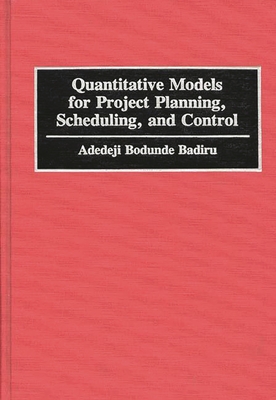
Today, a major component of any project management effort is the combined use of qualitative and quantitative tools. While publications on qualitative approaches to project management are widely available, few project management books have focused on the quantitative approaches. This book represents the first major project management book with a practical focus on the quantitative approaches to project management. The book organizes quantitative techniques into an integrated framework for project planning, scheduling, and control. Numerous illustrative examples are presented.
Topics covered in the book include PERT/CPM/PDM and extensions, mathematical project scheduling, heuristic project scheduling, project economics, statistical data analysis for project planning, computer simulation, assignment and transportation problems, and learning curve analysis. Chapter one gives a brief overview of project management, presenting a general-purpose project management model. Chapter two covers CPM, PERT, and PDM network techniques. Chapter three covers project scheduling subject to resource constraints. Chapter four covers project optimization. Chapter five discusses economic analysis for project planning and control. Chapter six discusses learning curve analysis. Chapter seven covers statistical data analysis for project planning and control. Chapter eight presents techniques for project analysis and selection. Tables and figures are used throughout the book to enhance the effectiveness of the discussions. This book is excellent as a textbook for upper-level undergraduate and graduate courses in Industrial Engineering, Engineering Management, and Business, and as a detailed, comprehensive guide for corporate management.
Log in to write a review for this book.
No reviews yet. Be the first to share your opinion.
Biography not available.