Reisman, Arnold Author
Biography not available.

Browse all 102025 books
Browse all 22025 books
Browse all 82025 books
Browse all ART CRITICISM books
Browse all Ashworth books
Browse all FOLKLORE books
Browse all GARDENS books
Browse all GRAPHIC NOVELS books
Browse all Hamilton books
Browse all HISTORY - MEDIEVAL books
Browse all HUMOUR books
Browse all Juvenile Fiction : Biographical - Other books
Browse all Juvenile Fiction : Historical - Other books
Browse all Juvenile Fiction : Legends, Myths, & Fables - Other books
Browse all Juvenile Fiction : People & Places - Other books
Browse all Juvenile Fiction : People & Places - United States - Other books
Browse all Juvenile Fiction : Religious - Other books
Browse all Juvenile Nonfiction : History - Other books
Browse all Juvenile Nonfiction : Mathematics - Advanced books
Browse all Juvenile Nonfiction : People & Places - Other books
Browse all Juvenile Nonfiction : People & Places - United States - Othe books
Browse all KINDRED books
Browse all LITERARY STUDIES books
Browse all LONDON books
Browse all Lozada books
Browse all Medical : Nursing - Mental Health books
Browse all MIND books
Browse all MUSEOLOGY books
Browse all NON-CLASSIFIABLE books
Browse all NONLINEAR SCIENCE books
Browse all Ormonde books
Browse all POPULAR SCIENCE books
Browse all RELIGIOUS STUDIES books
Browse all SPIRIT books
Browse all SPORT books
Browse all TRAVEL WRITING books
 Out of Stock
MGMT SCIENCE KNOWLEDGE
Hardback · ISBN 9780899307398
Inclusive of GST and other taxes
Arriving at your doorstep in 10-15 days
Our logisitcs team will make sure everyitem is delivered safely
| ISBN | 9780899307398 |
|---|---|
| Subtitle | MGMT SCIENCE KNOWLEDGE |
| Publisher | Praeger |
| Publication date | July 1992 |
| Language | English |
| MRP | £75.00 GBP |
| Page count | 324 |
| Item weight | 139 g |
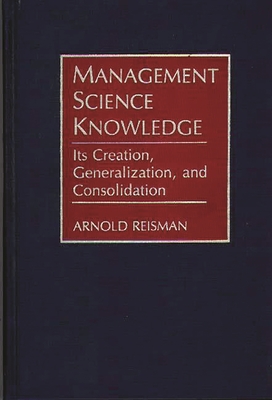
The science of management needs the kind of integrative thought given the science of chemistry by a Russian named D.I. Mendeleyev in 1889. Before Mendeleyev developed the periodic table, chemists knew of many seemingly unrelated elements just as management scientists today know of many seemingly unrelated models. This book discusses, classifies, and illustrates the various strategies and tactics for creating new knowledge, and for unifying, consolidating, and/or generalizing upon existing knowledge in the management sciences. Through generalization and systematization, it shows the interconnections, interrelations, and limitations of the various subdisciplines. Such knowledge is thus made more user-friendly, easier to learn to assimilate and hence to teach and to use.
Each of the philosophical, strategic, and tactical concepts discussed are amply illustrated. The illustrations reflect the breath of management science, both theory and applications. Much of the text, by design, is sourced from refereed journals serving archival functions in the various subareas of management science. This book is intended for graduate students about to enter the less structured and ill-defined world of research, and as a guide for their mentors. Project managers in industry and government who forever have to face ill-defined and unstructured problems may derive much benefit from the systematic approaches to problem solving discussed in this book. Lastly, the book is intended for funding agency executives as a means of improving the classification of research proposals. The book should enable future textbook authors to present their material in a much more unified fashion allowing the readers/students to see each bit of new material presented in its proper context.
Log in to write a review for this book.
No reviews yet. Be the first to share your opinion.
Biography not available.