Nagel, Stuart S. Editor
Biography not available.

Browse all ART CRITICISM books
Browse all Ashworth books
Browse all FOLKLORE books
Browse all GARDENS books
Browse all GRAPHIC NOVELS books
Browse all Hamilton books
Browse all HISTORY - MEDIEVAL books
Browse all HUMOUR books
Browse all Juvenile Fiction : Biographical - Other books
Browse all Juvenile Fiction : Historical - Other books
Browse all Juvenile Fiction : Legends, Myths, & Fables - Other books
Browse all Juvenile Fiction : People & Places - Other books
Browse all Juvenile Fiction : People & Places - United States - Other books
Browse all Juvenile Fiction : Religious - Other books
Browse all Juvenile Nonfiction : History - Other books
Browse all Juvenile Nonfiction : Mathematics - Advanced books
Browse all Juvenile Nonfiction : People & Places - Other books
Browse all Juvenile Nonfiction : People & Places - United States - Othe books
Browse all KINDRED books
Browse all LITERARY STUDIES books
Browse all LONDON books
Browse all Lozada books
Browse all Medical : Nursing - Mental Health books
Browse all MIND books
Browse all MUSEOLOGY books
Browse all NON-CLASSIFIABLE books
Browse all NONLINEAR SCIENCE books
Browse all Ormonde books
Browse all POPULAR SCIENCE books
Browse all RELIGIOUS STUDIES books
Browse all SPIRIT books
Browse all SPORT books
Browse all TRAVEL WRITING books
 Out of Stock
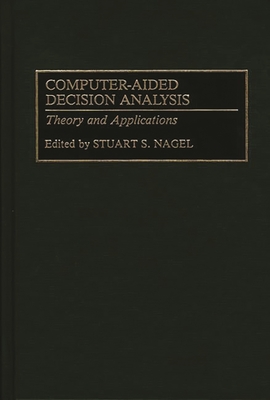
COMPUTER-AIDED DECISION ANALYS
Hardback · ISBN 9780899307718
Inclusive of GST and other taxes
Arriving at your doorstep in 10-15 days
Our logisitcs team will make sure everyitem is delivered safely
| ISBN | 9780899307718 |
|---|---|
| Subtitle | COMPUTER-AIDED DECISION ANALYS |
| Publisher | Praeger |
| Publication date | June 1993 |
| Language | English |
| MRP | £75.00 GBP |
| Page count | 300 |
| Item weight | 132 g |
The essence of decision-aiding software is that it consists of various forms of microcomputer programming designed to enable users to process a set of (1) goals to be achieved, (2) alternatives available for achieving them, and (3) relations between goals and alternatives in order to choose the best alternative, combination, allocation, or predictive decision-rule. Benefits from using decision-aiding software include (1) being more explicit about goals to be achieved, alternatives available for achieving them, and relations between goals and alternatives; (2) being stimulated to think of more goals, alternatives, and relations than one would otherwise be likely to do; (3) being prepared to handle multiple goals, alternatives, and relations without getting confused and without feeling the need to resort to a single composite goal or a single go/no-go alternative; (4) being encouraged to experiment with changes in the inputs into one's thinking to see how one's conclusions are affected; and (5) being better able to achieve or exceed one's goals when choosing among alternatives or allocating scarce resources.
There are five parts to the book covering: (1) a broad overview of decision-aiding packages, including criteria for evaluating them; (2) approaches that are based on management science and operations research, including linear programming and decision trees; (3) spreadsheet-based software, generally with goals on the columns, alternatives on the rows, relations in the cells, overall totals for each alternative at the far right, and a capability for indicating how the totals would be altered as a result of changes in the inputs; (4) expert systems software including rule-based and knowledge-based expert systems; and (5) general applications of decision-aiding software and a discussion of the increasing utilization of such software.
Log in to write a review for this book.
No reviews yet. Be the first to share your opinion.
Biography not available.
Biography not available.