Adams, Robert Author
Biography not available.

Browse all ART CRITICISM books
Browse all Ashworth books
Browse all FOLKLORE books
Browse all GARDENS books
Browse all GRAPHIC NOVELS books
Browse all Hamilton books
Browse all HISTORY - MEDIEVAL books
Browse all HUMOUR books
Browse all Juvenile Fiction : Biographical - Other books
Browse all Juvenile Fiction : Historical - Other books
Browse all Juvenile Fiction : Legends, Myths, & Fables - Other books
Browse all Juvenile Fiction : People & Places - Other books
Browse all Juvenile Fiction : People & Places - United States - Other books
Browse all Juvenile Fiction : Religious - Other books
Browse all Juvenile Nonfiction : History - Other books
Browse all Juvenile Nonfiction : Mathematics - Advanced books
Browse all Juvenile Nonfiction : People & Places - Other books
Browse all Juvenile Nonfiction : People & Places - United States - Othe books
Browse all KINDRED books
Browse all LITERARY STUDIES books
Browse all LONDON books
Browse all Lozada books
Browse all Medical : Nursing - Mental Health books
Browse all MIND books
Browse all MUSEOLOGY books
Browse all NON-CLASSIFIABLE books
Browse all NONLINEAR SCIENCE books
Browse all Ormonde books
Browse all POPULAR SCIENCE books
Browse all RELIGIOUS STUDIES books
Browse all SPIRIT books
Browse all SPORT books
Browse all TRAVEL WRITING books
 Out of Stock
Hardback · ISBN 9780990717621
Inclusive of GST and other taxes
Arriving at your doorstep in 10-15 days
Our logisitcs team will make sure everyitem is delivered safely
| ISBN | 9780990717621 |
|---|---|
| Publisher | Edwin & Associates |
| Publication date | January 2026 |
| Language | English |
| MRP | £74.99 GBP |
| Page count | 316 |
| Item weight | 169 g |
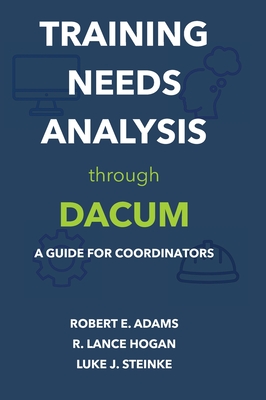
Training Needs Analysis through DACUM: A Guide for Coordinators is a comprehensive, practice-based guide to conducting systematic training needs analysis and occupational analysis using the DACUM (Develop A CurriculUM) system, originally developed by Robert E. Adams in 1968.
This book focuses explicitly on the analysis phase of occupational training development, addressing a critical weakness in many training programs: the failure to accurately diagnose performance problems and define job-relevant skills before designing instruction. Rather than assuming training is always the solution, the authors begin with performance analysis, guiding readers through methods for determining when training is appropriate and when performance issues stem from environmental, organizational, or motivational factors.
Central to the book is DACUM's expert-worker-driven approach to occupational analysis. Readers are guided step-by-step through the role of the DACUM coordinator, committee selection, coordinating techniques, skill identification, skill wording, and the construction and validation of DACUM charts organized around General Areas of Competence (GACs). Emphasis is placed on defining observable, measurable skills, avoiding abstract knowledge statements, and maintaining the integrity of the analysis process.
The book also explains the use of the DACUM rating scale to establish minimum acceptable levels of competence, differentiate performance expectations, and support later evaluation. While this volume concentrates on analysis, it intentionally situates that analysis within the broader DACUM Development Model, demonstrating how high-quality analysis becomes the foundation for curriculum development, learning activities, and performance-based evaluation.
Written for DACUM coordinators, training and development professionals, instructional designers, workforce educators, and career and technical education leaders, this book serves both as a technical reference and a working guide. It is designed to help professionals produce training programs that are efficient, defensible, and directly aligned with real occupational performance-avoiding over-training, under-training, and misaligned curricula.
As part of the DACUM series, Training Needs Analysis through DACUM stands as the definitive resource on conducting authentic DACUM-based analysis and preserving its role as the foundation of an integrated occupational training system.
Log in to write a review for this book.
No reviews yet. Be the first to share your opinion.
Biography not available.
Biography not available.
Biography not available.