Zhang, Jinhui Author
Biography not available.

Browse all FOLKLORE books
Browse all GARDENS books
Browse all GRAPHIC NOVELS books
Browse all HISTORY - MEDIEVAL books
Browse all HUMOUR books
Browse all Juvenile Fiction : Biographical - Other books
Browse all Juvenile Fiction : Historical - Other books
Browse all Juvenile Fiction : Legends, Myths, & Fables - Other books
Browse all Juvenile Fiction : People & Places - Other books
Browse all Juvenile Fiction : People & Places - United States - Other books
Browse all Juvenile Fiction : Religious - Other books
Browse all Juvenile Nonfiction : History - Other books
Browse all Juvenile Nonfiction : Mathematics - Advanced books
Browse all Juvenile Nonfiction : People & Places - Other books
Browse all Juvenile Nonfiction : People & Places - United States - Othe books
Browse all LITERARY STUDIES books
Browse all LONDON books
Browse all Medical : Nursing - Mental Health books
Browse all MIND books
Browse all MUSEOLOGY books
Browse all NON-CLASSIFIABLE books
Browse all NONLINEAR SCIENCE books
Browse all POPULAR SCIENCE books
Browse all RELIGIOUS STUDIES books
Browse all SPIRIT books
Browse all SPORT books
Browse all TRAVEL WRITING books
 Out of Stock
Hardback · ISBN 9781032197944
Inclusive of GST and other taxes
Arriving at your doorstep in 10-15 days
Our logisitcs team will make sure everyitem is delivered safely
| ISBN | 9781032197944 |
|---|---|
| Publisher | CRC Press |
| Publication date | January 2022 |
| Language | English |
| MRP | £103.99 GBP |
| Page count | 222 |
| Item weight | 134 g |
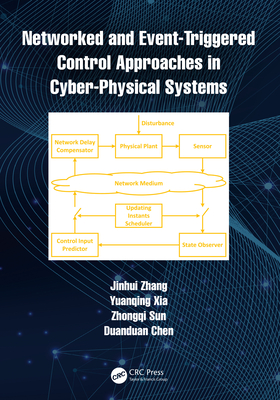
The insertion of communication networks in feedback control loops complicates analysis and synthesis of cyber-physical systems (CPSs), and network-induced uncertainties may degrade system control performance. Thus, this book researches networked delay compensation and event-triggered control approaches for a series of CPSs subject to network-induced uncertainties.
The authors begin with an introduction to the concepts and challenges of CPSs, followed by an overview of networked control approaches and event-triggered control strategies in CPSs. Then, networked delay compensation and event-triggered control approaches are proposed for CPSs with network communication delay, data dropout, signal quantization, and event-triggered communication. More specifically, networked delay compensation approaches are proposed for linear/nonlinear networked controlled plants with time-varying and random network communication delays and data dropouts. To reduce computational burden and network communication loads in CPSs, event-triggered control, self-triggered control, co-design of event-triggered control and quantized control techniques, and event-triggered disturbance rejection control approaches are also presented.
This book is an essential text for researchers and engineers interested in cybersecurity, networked control, and CPSs. It would also prove useful for graduate students in the fields of science, engineering, and computer science.
Log in to write a review for this book.
No reviews yet. Be the first to share your opinion.
Biography not available.
Biography not available.
Biography not available.