Saviotti, Pier Paolo Author
Biography not available.

Browse all FOLKLORE books
Browse all GARDENS books
Browse all GRAPHIC NOVELS books
Browse all HISTORY - MEDIEVAL books
Browse all HUMOUR books
Browse all Juvenile Fiction : Biographical - Other books
Browse all Juvenile Fiction : Historical - Other books
Browse all Juvenile Fiction : Legends, Myths, & Fables - Other books
Browse all Juvenile Fiction : People & Places - Other books
Browse all Juvenile Fiction : People & Places - United States - Other books
Browse all Juvenile Fiction : Religious - Other books
Browse all Juvenile Nonfiction : History - Other books
Browse all Juvenile Nonfiction : Mathematics - Advanced books
Browse all Juvenile Nonfiction : People & Places - Other books
Browse all Juvenile Nonfiction : People & Places - United States - Othe books
Browse all LITERARY STUDIES books
Browse all LONDON books
Browse all Medical : Nursing - Mental Health books
Browse all MIND books
Browse all MUSEOLOGY books
Browse all NON-CLASSIFIABLE books
Browse all NONLINEAR SCIENCE books
Browse all POPULAR SCIENCE books
Browse all RELIGIOUS STUDIES books
Browse all SPIRIT books
Browse all SPORT books
Browse all TRAVEL WRITING books
 Out of Stock
Paperback · ISBN 9781032278186
Inclusive of GST and other taxes
Arriving at your doorstep in 10-15 days
Our logisitcs team will make sure everyitem is delivered safely
| ISBN | 9781032278186 |
|---|---|
| Publisher | Routledge |
| Publication date | October 2024 |
| Language | English |
| MRP | £43.99 GBP |
| Page count | 298 |
| Item weight | 93 g |
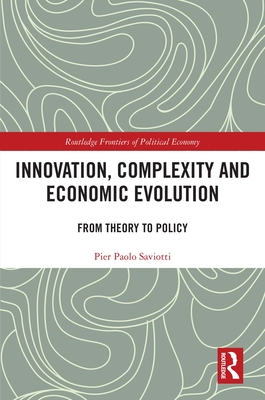
If evolutionary economics is to compete with neoclassical economics as a general-purpose economic theory, it needs to incorporate new aspects of socioeconomic reality, such as institutions of all types, including technical, scientific, and political. Furthermore, evolutionary economics needs to be able to provide policy implications at least as interesting as those of neoclassical economics. Thus, as this book argues, evolutionary economics must become evolutionary political economy.
Innovation plays a central role in the book, but not in the sense of providing a technologically determinist interpretation. Rather, the book argues that innovations do not emerge in isolation from other components of socioeconomic systems but coevolve with institutions, infrastructures and organizational forms. This concept of coevolution is absolutely central in the book and provides a link with theories of complexity. In addition to providing an epistemological basis for evolutionary economics, the link with complexity and coevolution offers the connection with evolutionary political economy. Innovations and technologies do not emerge and develop in an institutional vacuum, but interact with existing institutions and reshape them, in addition to inducing the formation of new institutions. In this process, technologies and institutions reinforce each other providing a potential mechanism to transform socioeconomic systems. The book also explores the policy implications of these innovative societies, where wealth is created but unequally distributed.
The book is addressed to open-minded economists, social scientists who are dissatisfied with the approach of neoclassical economics, technologists and policy makers.
Log in to write a review for this book.
No reviews yet. Be the first to share your opinion.
Biography not available.