Stirling, Wynn C. Author
Biography not available.

Browse all FOLKLORE books
Browse all GARDENS books
Browse all GRAPHIC NOVELS books
Browse all HISTORY - MEDIEVAL books
Browse all HUMOUR books
Browse all Juvenile Fiction : Biographical - Other books
Browse all Juvenile Fiction : Historical - Other books
Browse all Juvenile Fiction : Legends, Myths, & Fables - Other books
Browse all Juvenile Fiction : People & Places - Other books
Browse all Juvenile Fiction : People & Places - United States - Other books
Browse all Juvenile Fiction : Religious - Other books
Browse all Juvenile Nonfiction : History - Other books
Browse all Juvenile Nonfiction : Mathematics - Advanced books
Browse all Juvenile Nonfiction : People & Places - Other books
Browse all Juvenile Nonfiction : People & Places - United States - Othe books
Browse all LITERARY STUDIES books
Browse all LONDON books
Browse all Medical : Nursing - Mental Health books
Browse all MIND books
Browse all MUSEOLOGY books
Browse all NON-CLASSIFIABLE books
Browse all NONLINEAR SCIENCE books
Browse all POPULAR SCIENCE books
Browse all RELIGIOUS STUDIES books
Browse all SPIRIT books
Browse all SPORT books
Browse all TRAVEL WRITING books
 Out of Stock
Hardback · ISBN 9781107011748
Inclusive of GST and other taxes
Arriving at your doorstep in 10-15 days
Our logisitcs team will make sure everyitem is delivered safely
| ISBN | 9781107011748 |
|---|---|
| Publisher | Cambridge University Press |
| Publication date | March 2012 |
| Language | English |
| MRP | £120.00 GBP |
| Page count | 252 |
| Item weight | 112 g |
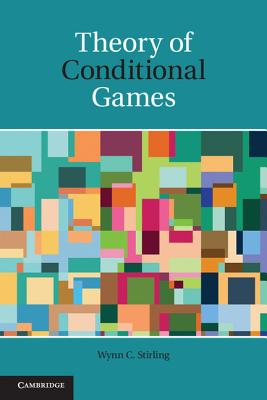
Game theory explains how to make good choices when different decision makers have conflicting interests. The classical approach assumes that decision makers are committed to making the best choices for themselves regardless of the effect on others, but such an approach is less appropriate when cooperation, compromise, and negotiation are important. This book describes conditional games, a form of game theory that accommodates multiple stakeholder decision-making scenarios where cooperation and negotiation are significant issues and where notions of concordant group behavior are important. Using classical binary preference relations as a point of departure, the book extends the concept of a preference ordering that permits stakeholders to modulate their preferences as functions of the preferences of others. As these conditional preferences propagate through a group of decision makers, they create social bonds that lead to notions of group concordance. This book is intended for all students and researchers of decision theory and game theory, including students in artificial intelligence (especially multiagent systems and distributed control), economics, management science, psychology, analytic philosophy, and applied mathematics.
Log in to write a review for this book.
No reviews yet. Be the first to share your opinion.
Biography not available.