Thompson, Sandra A. Author
Biography not available.

Browse all FOLKLORE books
Browse all GARDENS books
Browse all GRAPHIC NOVELS books
Browse all HISTORY - MEDIEVAL books
Browse all HUMOUR books
Browse all Juvenile Fiction : Biographical - Other books
Browse all Juvenile Fiction : Historical - Other books
Browse all Juvenile Fiction : Legends, Myths, & Fables - Other books
Browse all Juvenile Fiction : People & Places - Other books
Browse all Juvenile Fiction : People & Places - United States - Other books
Browse all Juvenile Fiction : Religious - Other books
Browse all Juvenile Nonfiction : History - Other books
Browse all Juvenile Nonfiction : Mathematics - Advanced books
Browse all Juvenile Nonfiction : People & Places - Other books
Browse all Juvenile Nonfiction : People & Places - United States - Othe books
Browse all LITERARY STUDIES books
Browse all LONDON books
Browse all Medical : Nursing - Mental Health books
Browse all MIND books
Browse all MUSEOLOGY books
Browse all NON-CLASSIFIABLE books
Browse all NONLINEAR SCIENCE books
Browse all POPULAR SCIENCE books
Browse all RELIGIOUS STUDIES books
Browse all SPIRIT books
Browse all SPORT books
Browse all TRAVEL WRITING books
 Out of Stock
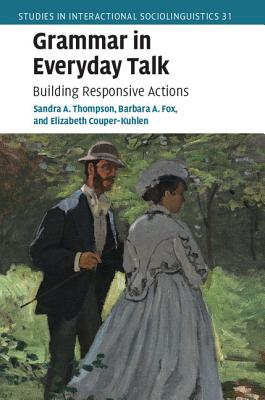
GRAMMAR IN EVERYDAY TALK
Hardback · ISBN 9781107031029
Inclusive of GST and other taxes
Arriving at your doorstep in 10-15 days
Our logisitcs team will make sure everyitem is delivered safely
| ISBN | 9781107031029 |
|---|---|
| Subtitle | GRAMMAR IN EVERYDAY TALK |
| Publisher | Cambridge University Press |
| Publication date | April 2015 |
| Language | English |
| MRP | £120.00 GBP |
| Page count | 356 |
| Item weight | 142 g |
Drawing on everyday telephone and video interactions, this book surveys how English speakers use grammar to formulate responses in ordinary conversation. The authors show that speakers build their responses in a variety of ways: the responses can be longer or shorter, repetitive or not, and can be uttered with different intonational 'melodies'. Focusing on four sequence types: responses to questions ('What time are we leaving?' - 'Seven'), responses to informings ('The May Company are sure having a big sale' - 'Are they?'), responses to assessments ('Track walking is so boring. Even with headphones' - 'It is'), and responses to requests ('Please don't tell Adeline' - 'Oh no I won't say anything'), they argue that an interactional approach holds the key to explaining why some types of utterances in English conversation seem to have something 'missing' and others seem overly wordy.
Log in to write a review for this book.
No reviews yet. Be the first to share your opinion.
Biography not available.
Biography not available.
Biography not available.