Elster, Jon Author
Biography not available.

Browse all FOLKLORE books
Browse all GARDENS books
Browse all GRAPHIC NOVELS books
Browse all HISTORY - MEDIEVAL books
Browse all HUMOUR books
Browse all Juvenile Fiction : Biographical - Other books
Browse all Juvenile Fiction : Historical - Other books
Browse all Juvenile Fiction : Legends, Myths, & Fables - Other books
Browse all Juvenile Fiction : People & Places - Other books
Browse all Juvenile Fiction : People & Places - United States - Other books
Browse all Juvenile Fiction : Religious - Other books
Browse all Juvenile Nonfiction : History - Other books
Browse all Juvenile Nonfiction : Mathematics - Advanced books
Browse all Juvenile Nonfiction : People & Places - Other books
Browse all Juvenile Nonfiction : People & Places - United States - Othe books
Browse all LITERARY STUDIES books
Browse all LONDON books
Browse all Medical : Nursing - Mental Health books
Browse all MIND books
Browse all MUSEOLOGY books
Browse all NON-CLASSIFIABLE books
Browse all NONLINEAR SCIENCE books
Browse all POPULAR SCIENCE books
Browse all RELIGIOUS STUDIES books
Browse all SPIRIT books
Browse all SPORT books
Browse all TRAVEL WRITING books
 Out of Stock
SECURITIES AGAINST MISRULE
Hardback · ISBN 9781107031739
Inclusive of GST and other taxes
Arriving at your doorstep in 10-15 days
Our logisitcs team will make sure everyitem is delivered safely
| ISBN | 9781107031739 |
|---|---|
| Subtitle | SECURITIES AGAINST MISRULE |
| Publisher | Cambridge University Press |
| Publication date | April 2013 |
| Language | English |
| MRP | £78.00 GBP |
| Page count | 338 |
| Item weight | 154 g |
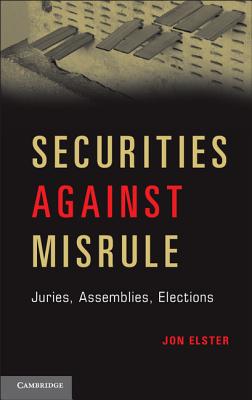
This book proposes a normative theory of collective decision making, inspired by Jeremy Bentham but not including his utilitarian philosophy. The central proposal is that in designing democratic institutions one should reduce as much as possible the impact of self-interest, passion, prejudice, and bias on the decision makers, and then let the chips fall where they may. There is no independently defined good outcome that institutions can track, nor is there any way of reliably selecting good decision makers. In addition to a long initial chapter that surveys theories of collective decision making, notably social-choice theory, and a chapter expounding and discussing Bentham's views, historical chapters on the jury, constituent assemblies, and electoral systems develop and illustrate the main ideas. This work draws on a welter of case studies and historical episodes, from Thucydides and Plutarch to the present. It is also grounded in psychology, behavioral economics, and law.
Log in to write a review for this book.
No reviews yet. Be the first to share your opinion.
Biography not available.