Weirich, Paul Author
Biography not available.

Browse all FOLKLORE books
Browse all GARDENS books
Browse all GRAPHIC NOVELS books
Browse all HISTORY - MEDIEVAL books
Browse all HUMOUR books
Browse all Juvenile Fiction : Biographical - Other books
Browse all Juvenile Fiction : Historical - Other books
Browse all Juvenile Fiction : Legends, Myths, & Fables - Other books
Browse all Juvenile Fiction : People & Places - Other books
Browse all Juvenile Fiction : People & Places - United States - Other books
Browse all Juvenile Fiction : Religious - Other books
Browse all Juvenile Nonfiction : History - Other books
Browse all Juvenile Nonfiction : Mathematics - Advanced books
Browse all Juvenile Nonfiction : People & Places - Other books
Browse all Juvenile Nonfiction : People & Places - United States - Othe books
Browse all LITERARY STUDIES books
Browse all LONDON books
Browse all Medical : Nursing - Mental Health books
Browse all MIND books
Browse all MUSEOLOGY books
Browse all NON-CLASSIFIABLE books
Browse all NONLINEAR SCIENCE books
Browse all POPULAR SCIENCE books
Browse all RELIGIOUS STUDIES books
Browse all SPIRIT books
Browse all SPORT books
Browse all TRAVEL WRITING books
 Out of Stock
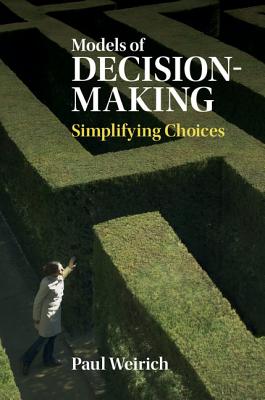
MODELS OF DECISION-MAKING
Hardback · ISBN 9781107077799
Inclusive of GST and other taxes
Arriving at your doorstep in 10-15 days
Our logisitcs team will make sure everyitem is delivered safely
| ISBN | 9781107077799 |
|---|---|
| Subtitle | MODELS OF DECISION-MAKING |
| Publisher | Cambridge University Press |
| Publication date | May 2015 |
| Language | English |
| MRP | £95.00 GBP |
| Page count | 276 |
| Item weight | 119 g |
Classical decision theory evaluates entire worlds, specified so as to include everything a decision-maker cares about. Thus applying decision theory requires performing computations far beyond an ordinary decision-maker's ability. In this book Paul Weirich explains how individuals can simplify and streamline their choices. He shows how different 'parts' of options (intrinsic, temporal, spatiotemporal, causal) are separable, so that we can know what difference one part makes to the value of an option, regardless of what happens in the other parts. He suggests that the primary value of options is found in basic intrinsic attitudes towards outcomes: desires, aversions, or indifferences. And using these two facts he argues that we need only compare small parts of the options we face in order to make a rational decision. This important book will interest readers in decision theory, economics, and the behavioral sciences.
Log in to write a review for this book.
No reviews yet. Be the first to share your opinion.
Biography not available.