Refini, Eugenio Author
Biography not available.

Browse all FOLKLORE books
Browse all GARDENS books
Browse all GRAPHIC NOVELS books
Browse all HISTORY - MEDIEVAL books
Browse all HUMOUR books
Browse all Juvenile Fiction : Biographical - Other books
Browse all Juvenile Fiction : Historical - Other books
Browse all Juvenile Fiction : Legends, Myths, & Fables - Other books
Browse all Juvenile Fiction : People & Places - Other books
Browse all Juvenile Fiction : People & Places - United States - Other books
Browse all Juvenile Fiction : Religious - Other books
Browse all Juvenile Nonfiction : History - Other books
Browse all Juvenile Nonfiction : Mathematics - Advanced books
Browse all Juvenile Nonfiction : People & Places - Other books
Browse all Juvenile Nonfiction : People & Places - United States - Othe books
Browse all LITERARY STUDIES books
Browse all LONDON books
Browse all Medical : Nursing - Mental Health books
Browse all MIND books
Browse all MUSEOLOGY books
Browse all NON-CLASSIFIABLE books
Browse all NONLINEAR SCIENCE books
Browse all POPULAR SCIENCE books
Browse all RELIGIOUS STUDIES books
Browse all SPIRIT books
Browse all SPORT books
Browse all TRAVEL WRITING books
 Out of Stock
Hardback · ISBN 9781108481816
Inclusive of GST and other taxes
Arriving at your doorstep in 10-15 days
Our logisitcs team will make sure everyitem is delivered safely
| ISBN | 9781108481816 |
|---|---|
| Publisher | Cambridge University Press |
| Publication date | February 2020 |
| Language | English |
| MRP | £99.00 GBP |
| Page count | 298 |
| Item weight | 125 g |
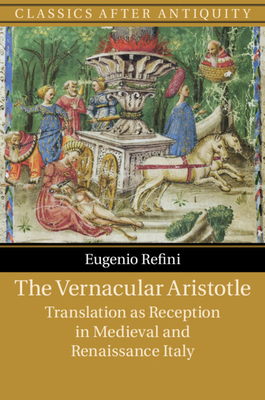
This book explores the ways in which Aristotle's legacy was appropriated and reshaped by vernacular readers in Medieval and Renaissance Italy. It considers translation in a broad sense, looking at commentaries, compendia, rewritings, and abridgments alongside vernacular versions of Aristotle's works. Translation is thus taken as quintessential to the very notion of reception, with a focus on the dynamics - cultural, social, material - that informed the appropriation and reshaping of the 'master of those who know' on the part of vernacular readers between 1250 and 1500. By looking at the proactive and transformative nature of reception, this book challenges traditional narratives about the period and identifies the theory and practice of translation as a liminal space that facilitated the interaction between lay readers and the academic context while fostering the legitimation of the vernacular as a language suitable for philosophical discourse.
Log in to write a review for this book.
No reviews yet. Be the first to share your opinion.
Biography not available.