Richards, I. A. Author
Biography not available.

Browse all FOLKLORE books
Browse all GARDENS books
Browse all GRAPHIC NOVELS books
Browse all HISTORY - MEDIEVAL books
Browse all HUMOUR books
Browse all Juvenile Fiction : Biographical - Other books
Browse all Juvenile Fiction : Historical - Other books
Browse all Juvenile Fiction : Legends, Myths, & Fables - Other books
Browse all Juvenile Fiction : People & Places - Other books
Browse all Juvenile Fiction : People & Places - United States - Other books
Browse all Juvenile Fiction : Religious - Other books
Browse all Juvenile Nonfiction : History - Other books
Browse all Juvenile Nonfiction : Mathematics - Advanced books
Browse all Juvenile Nonfiction : People & Places - Other books
Browse all Juvenile Nonfiction : People & Places - United States - Othe books
Browse all LITERARY STUDIES books
Browse all LONDON books
Browse all Medical : Nursing - Mental Health books
Browse all MIND books
Browse all MUSEOLOGY books
Browse all NON-CLASSIFIABLE books
Browse all NONLINEAR SCIENCE books
Browse all POPULAR SCIENCE books
Browse all RELIGIOUS STUDIES books
Browse all SPIRIT books
Browse all SPORT books
Browse all TRAVEL WRITING books
 Out of Stock
Hardback · ISBN 9781138530638
Inclusive of GST and other taxes
Arriving at your doorstep in 10-15 days
Our logisitcs team will make sure everyitem is delivered safely
| ISBN | 9781138530638 |
|---|---|
| Publisher | Routledge |
| Publication date | August 2017 |
| Language | English |
| MRP | £187.99 GBP |
| Page count | 382 |
| Item weight | 150 g |
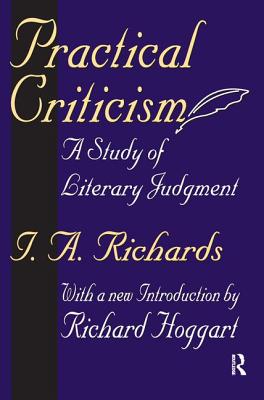
Linguist, critic, poet, psychologist, I. A. Richards (1893-1979) was one of the great polymaths of the twentieth century. He is best known, however, as one of the founders of modern literary critical theory. Richards revolutionized criticism by turning away from biographical and historical readings as well as from the aesthetic impressionism. Seeking a more exacting approach, he analyzed literary texts as syntactical structures that could be broken down into smaller interacting verbal units of meaning. Practical Criticism, first published in 1929, is a landmark volume in demonstrating this method.Practical Criticism was born of an experiment Richards undertook to discern the psychological foundations of reading and interpretation and a means for readers to discover how they think and feel about poetry. He submitted thirteen poems for analysis, without date or author given, to some four hundred of his Cambridge students. Poets of stature went in undifferentiated from obscure and forgotten figures. The results were mixed at best, with many of the interpretations shockingly bad. These readings were based, in large part, not on the texts themselves but on then-current opinions, presuppositions, theories, and beliefs. The results led Richards to define a set of interrelated mental obstacles to intelligent and accurate reading including "irrelevant associations," "stock responses," "sentimentality," and a general misunderstanding of the purpose or "doctrine" of poetry.Richards' concerns in Practical Criticism went well beyond the merely formal. In the humanist tradition, he believed that the ability to read critically and use language truthfully was culturally regenerative, a necessary skill in the modern world of mass-produced art and advertising. This classic volume will be of interest to teachers of literature, cultural studies specialists, and intellectual historians.
Log in to write a review for this book.
No reviews yet. Be the first to share your opinion.
Biography not available.