Cizek, Gregory J. Editor
Biography not available.

Browse all FOLKLORE books
Browse all GARDENS books
Browse all GRAPHIC NOVELS books
Browse all HISTORY - MEDIEVAL books
Browse all HUMOUR books
Browse all Juvenile Fiction : Biographical - Other books
Browse all Juvenile Fiction : Historical - Other books
Browse all Juvenile Fiction : Legends, Myths, & Fables - Other books
Browse all Juvenile Fiction : People & Places - Other books
Browse all Juvenile Fiction : People & Places - United States - Other books
Browse all Juvenile Fiction : Religious - Other books
Browse all Juvenile Nonfiction : History - Other books
Browse all Juvenile Nonfiction : Mathematics - Advanced books
Browse all Juvenile Nonfiction : People & Places - Other books
Browse all Juvenile Nonfiction : People & Places - United States - Othe books
Browse all LITERARY STUDIES books
Browse all LONDON books
Browse all Medical : Nursing - Mental Health books
Browse all MIND books
Browse all MUSEOLOGY books
Browse all NON-CLASSIFIABLE books
Browse all NONLINEAR SCIENCE books
Browse all POPULAR SCIENCE books
Browse all RELIGIOUS STUDIES books
Browse all SPIRIT books
Browse all SPORT books
Browse all TRAVEL WRITING books
 Out of Stock
Hardback · ISBN 9781138821804
Inclusive of GST and other taxes
Arriving at your doorstep in 10-15 days
Our logisitcs team will make sure everyitem is delivered safely
| ISBN | 9781138821804 |
|---|---|
| Publisher | Routledge |
| Publication date | October 2016 |
| Language | English |
| MRP | £315.00 GBP |
| Page count | 446 |
| Item weight | 218 g |
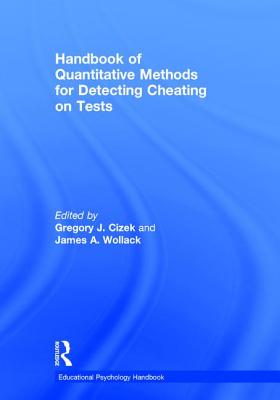
The rising reliance on testing in American education and for licensure and certification has been accompanied by an escalation in cheating on tests at all levels. Edited by two of the foremost experts on the subject, the Handbook of Quantitative Methods for Detecting Cheating on Tests offers a comprehensive compendium of increasingly sophisticated data forensics used to investigate whether or not cheating has occurred. Written for practitioners, testing professionals, and scholars in testing, measurement, and assessment, this volume builds on the claim that statistical evidence often requires less of an inferential leap to conclude that cheating has taken place than do other, more common sources of evidence.
This handbook is organized into sections that roughly correspond to the kinds of threats to fair testing represented by different forms of cheating. In Section I, the editors outline the fundamentals and significance of cheating, and they introduce the common datasets to which chapter authors' cheating detection methods were applied. Contributors describe, in Section II, methods for identifying cheating in terms of improbable similarity in test responses, preknowledge and compromised test content, and test tampering. Chapters in Section III concentrate on policy and practical implications of using quantitative detection methods. Synthesis across methodological chapters as well as an overall summary, conclusions, and next steps for the field are the key aspects of the final section.
Log in to write a review for this book.
No reviews yet. Be the first to share your opinion.
Biography not available.
Biography not available.