Liz-Marzán, Luis M. Editor
Biography not available.

Browse all FOLKLORE books
Browse all GARDENS books
Browse all GRAPHIC NOVELS books
Browse all HISTORY - MEDIEVAL books
Browse all HUMOUR books
Browse all Juvenile Fiction : Biographical - Other books
Browse all Juvenile Fiction : Historical - Other books
Browse all Juvenile Fiction : Legends, Myths, & Fables - Other books
Browse all Juvenile Fiction : People & Places - Other books
Browse all Juvenile Fiction : People & Places - United States - Other books
Browse all Juvenile Fiction : Religious - Other books
Browse all Juvenile Nonfiction : History - Other books
Browse all Juvenile Nonfiction : Mathematics - Advanced books
Browse all Juvenile Nonfiction : People & Places - Other books
Browse all Juvenile Nonfiction : People & Places - United States - Othe books
Browse all LITERARY STUDIES books
Browse all LONDON books
Browse all Medical : Nursing - Mental Health books
Browse all MIND books
Browse all MUSEOLOGY books
Browse all NON-CLASSIFIABLE books
Browse all NONLINEAR SCIENCE books
Browse all POPULAR SCIENCE books
Browse all RELIGIOUS STUDIES books
Browse all SPIRIT books
Browse all SPORT books
Browse all TRAVEL WRITING books
 Out of Stock
LOW-DIMENSIONAL SYSTEMS THEORY
Paperback · ISBN 9781402011696
Inclusive of GST and other taxes
Arriving at your doorstep in 10-15 days
Our logisitcs team will make sure everyitem is delivered safely
| ISBN | 9781402011696 |
|---|---|
| Subtitle | LOW-DIMENSIONAL SYSTEMS THEORY |
| Publisher | Springer |
| Publication date | March 2003 |
| Language | English |
| MRP | £44.99 GBP |
| Page count | 348 |
| Item weight | 108 g |
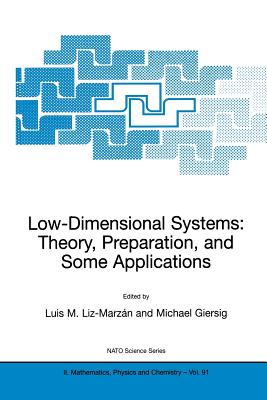
This volume contains papers presented at the NATO Advanced Research Workshop (ARW) Dynamic Interactions in Quantum Dot Systems held at Hotel Atrium in Puszczykowo, near Poznan, Poland, May 16-19,2002. The term low-dimensional systems, which is used in the title of this volume, refers to those systems which contain at least one dimension that is intermediate between those characteristic ofatoms/molecules and those ofthe bulk material. Depending on how many dimensions lay within this range, we generally speak of quantum wells, quantum wires, and quantum dots. As such an intermediate state, some properties of low-dimensional systems are very different to those of their molecular and bulk counterparts. These properties generally include optical, electronic, and magnetic properties, and all these are partially covered in this book. The main goal of the workshop was to discuss the actual state of the art in the broad area ofnanotechnology. The initial focus was on the innovative synthesis of nanomaterials and their properties such as: quantum size effects, superparamagnetism, or field emission. These topics lead us into the various field based interactions including plasmon- magnetic - spin- and exciton coupling. The newer, more sophisticated methods for characterization of nanomaterials were discussed, as well as the methods for possible industrial applications. In general, chemists and physicists, as well as experts on both theory and experiments on nanosized regime structures were brought together, to discuss the general phenomena underlying their fields ofinterest from different points ofview.
Log in to write a review for this book.
No reviews yet. Be the first to share your opinion.
Biography not available.
Biography not available.