Gafney, Leo Author
Biography not available.

Browse all FOLKLORE books
Browse all GARDENS books
Browse all GRAPHIC NOVELS books
Browse all HISTORY - MEDIEVAL books
Browse all HUMOUR books
Browse all Juvenile Fiction : Biographical - Other books
Browse all Juvenile Fiction : Historical - Other books
Browse all Juvenile Fiction : Legends, Myths, & Fables - Other books
Browse all Juvenile Fiction : People & Places - Other books
Browse all Juvenile Fiction : People & Places - United States - Other books
Browse all Juvenile Fiction : Religious - Other books
Browse all Juvenile Nonfiction : History - Other books
Browse all Juvenile Nonfiction : Mathematics - Advanced books
Browse all Juvenile Nonfiction : People & Places - Other books
Browse all Juvenile Nonfiction : People & Places - United States - Othe books
Browse all LITERARY STUDIES books
Browse all LONDON books
Browse all Medical : Nursing - Mental Health books
Browse all MIND books
Browse all MUSEOLOGY books
Browse all NON-CLASSIFIABLE books
Browse all NONLINEAR SCIENCE books
Browse all POPULAR SCIENCE books
Browse all RELIGIOUS STUDIES books
Browse all SPIRIT books
Browse all SPORT books
Browse all TRAVEL WRITING books
 Out of Stock
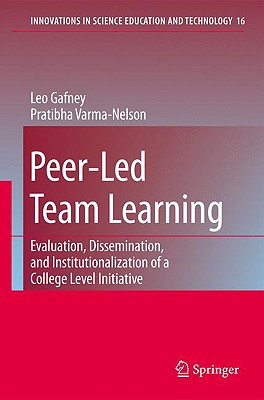
PEER LED TEAM LEARNING
Hardback · ISBN 9781402061851
Inclusive of GST and other taxes
Arriving at your doorstep in 10-15 days
Our logisitcs team will make sure everyitem is delivered safely
| ISBN | 9781402061851 |
|---|---|
| Subtitle | PEER LED TEAM LEARNING |
| Publisher | Springer |
| Publication date | July 2008 |
| Language | English |
| MRP | £89.99 GBP |
| Page count | 168 |
| Item weight | 92 g |
There seems to be no end to the flood of conferences, workshops, panel discussions, reports and research studies calling for change in the introductory science courses in our colleges and universities. But, there comes a time to move from criticism to action. In 1993, the Division of Undergraduate Education of the National Science Foundation called for proposals for systemic initiatives to change the way int- ductory chemistry is taught. One of the five awards was to design, develop and implement the peer-led Workshop, a new structure to help students learn science. This book is a study of 15 years of work by the Peer-Led Team Learning (PLTL) project, a national consortium of faculty, learning specialists and students. The authors have been in the thick of the action as project evaluator (Gafney) and co-principle investigator (Varma-Nelson). Readers of this book will find a story of successful change in educational practice, a story that continues today as new institutions, faculty, and disciplines adopt the PLTL model. They will learn the model in theory and in practice and the supporting data that encourage others to adopt and adapt PLTL to new sit- tions. Although the project has long since lost count of the number of implem- tations of the model, conservative estimates are that more than 100 community and four year colleges and a range of universities have adopted the PLTL model to advance student learning for more than 20,000 students in a variety of STEM disciplines.
Log in to write a review for this book.
No reviews yet. Be the first to share your opinion.
Biography not available.
Biography not available.