March, James G. Author
Biography not available.

Browse all FOLKLORE books
Browse all GARDENS books
Browse all GRAPHIC NOVELS books
Browse all HISTORY - MEDIEVAL books
Browse all HUMOUR books
Browse all Juvenile Fiction : Biographical - Other books
Browse all Juvenile Fiction : Historical - Other books
Browse all Juvenile Fiction : Legends, Myths, & Fables - Other books
Browse all Juvenile Fiction : People & Places - Other books
Browse all Juvenile Fiction : People & Places - United States - Other books
Browse all Juvenile Fiction : Religious - Other books
Browse all Juvenile Nonfiction : History - Other books
Browse all Juvenile Nonfiction : Mathematics - Advanced books
Browse all Juvenile Nonfiction : People & Places - Other books
Browse all Juvenile Nonfiction : People & Places - United States - Othe books
Browse all LITERARY STUDIES books
Browse all LONDON books
Browse all Medical : Nursing - Mental Health books
Browse all MIND books
Browse all MUSEOLOGY books
Browse all NON-CLASSIFIABLE books
Browse all NONLINEAR SCIENCE books
Browse all POPULAR SCIENCE books
Browse all RELIGIOUS STUDIES books
Browse all SPIRIT books
Browse all SPORT books
Browse all TRAVEL WRITING books
 Out of Stock
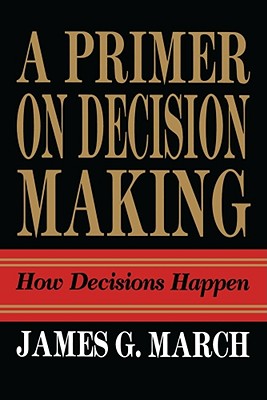
PRIMER ON DECISION MAKING
Paperback · ISBN 9781439157336
Inclusive of GST and other taxes
Arriving at your doorstep in 10-15 days
Our logisitcs team will make sure everyitem is delivered safely
| ISBN | 9781439157336 |
|---|---|
| Subtitle | PRIMER ON DECISION MAKING |
| Publisher | Free Press |
| Publication date | January 2009 |
| Language | English |
| MRP | £16.99 GBP |
| Page count | 314 |
| Item weight | 84 g |
March sheds new light on the decision-making process by delineating four deep issues that persistently divide students of decision making: Are decisions based on rational choices involving preferences and expected consequences, or on rules that are appropriate to the identity of the decision maker and the situation? Is decision making a consistent, clear process or one characterized by ambiguity and inconsistency? Is decision making significant primarily for its outcomes, or for the individual and social meanings it creates and sustains? And finally, are the outcomes of decision processes attributable solely to the actions of individuals, or to the combined influence of interacting individuals, organizations, and societies? March's observations on how intelligence is -- or is not -- achieved through decision making, and possibilities for enhancing decision intelligence, are also provided.
March explains key concepts of vital importance to students of decision making and decision makers, such as limited rationality, history-dependent rules, and ambiguity, and weaves these ideas into a full depiction of decision making.
He includes a discussion of the modern aspects of several classic issues underlying these concepts, such as the relation between reason and ignorance, intentionality and fate, and meaning and interpretation.
This valuable textbook by one of the seminal figures in the history of organizational decision making will be required reading for a new generation of scholars, managers, and other decision makers.
Log in to write a review for this book.
No reviews yet. Be the first to share your opinion.
Biography not available.