Sijtsma, Klaas Author
Biography not available.

Browse all FOLKLORE books
Browse all GARDENS books
Browse all GRAPHIC NOVELS books
Browse all HISTORY - MEDIEVAL books
Browse all HUMOUR books
Browse all Juvenile Fiction : Biographical - Other books
Browse all Juvenile Fiction : Historical - Other books
Browse all Juvenile Fiction : Legends, Myths, & Fables - Other books
Browse all Juvenile Fiction : People & Places - Other books
Browse all Juvenile Fiction : People & Places - United States - Other books
Browse all Juvenile Fiction : Religious - Other books
Browse all Juvenile Nonfiction : History - Other books
Browse all Juvenile Nonfiction : Mathematics - Advanced books
Browse all Juvenile Nonfiction : People & Places - Other books
Browse all Juvenile Nonfiction : People & Places - United States - Othe books
Browse all LITERARY STUDIES books
Browse all LONDON books
Browse all Medical : Nursing - Mental Health books
Browse all MIND books
Browse all MUSEOLOGY books
Browse all NON-CLASSIFIABLE books
Browse all NONLINEAR SCIENCE books
Browse all POPULAR SCIENCE books
Browse all RELIGIOUS STUDIES books
Browse all SPIRIT books
Browse all SPORT books
Browse all TRAVEL WRITING books
 Out of Stock
Hardback · ISBN 9781439881347
Inclusive of GST and other taxes
Arriving at your doorstep in 10-15 days
Our logisitcs team will make sure everyitem is delivered safely
| ISBN | 9781439881347 |
|---|---|
| Publisher | Chapman and Hall/CRC |
| Publication date | October 2020 |
| Language | English |
| MRP | £210.00 GBP |
| Page count | 430 |
| Item weight | 171 g |
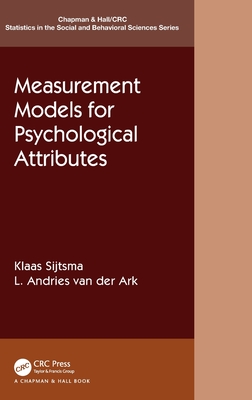
Despite the overwhelming use of tests and questionnaires, the psychometric models for constructing these instruments are often poorly understood, leading to suboptimal measurement. Measurement Models for Psychological Attributes is a comprehensive and accessible treatment of the common and the less than common measurement models for the social, behavioral, and health sciences. The monograph explains the adequate use of measurement models for test construction, points out their merits and drawbacks, and critically discusses topics that have raised and continue to raise controversy. Because introductory texts on statistics and psychometrics are sufficient to understand its content, the monograph may be used in advanced courses on applied psychometrics and is attractive to both researchers and graduate students in psychology, education, sociology, political science, medicine and marketing, policy research, and opinion research.
The monograph provides an in-depth discussion of classical test theory and factor models in Chapter 2; nonparametric and parametric item response theory in Chapter 3 and Chapter 4, respectively; latent class models and cognitive diagnosis models in Chapter 5; and discusses pairwise comparison models, proximity models, response time models, and network psychometrics in Chapter 6. The chapters start with the theory and methods of the measurement model and conclude with a real-data example illustrating the measurement model.
Log in to write a review for this book.
No reviews yet. Be the first to share your opinion.
Biography not available.
Biography not available.