Berezin, Vladimir Editor
Biography not available.

Browse all FOLKLORE books
Browse all GARDENS books
Browse all GRAPHIC NOVELS books
Browse all HISTORY - MEDIEVAL books
Browse all HUMOUR books
Browse all Juvenile Fiction : Biographical - Other books
Browse all Juvenile Fiction : Historical - Other books
Browse all Juvenile Fiction : Legends, Myths, & Fables - Other books
Browse all Juvenile Fiction : People & Places - Other books
Browse all Juvenile Fiction : People & Places - United States - Other books
Browse all Juvenile Fiction : Religious - Other books
Browse all Juvenile Nonfiction : History - Other books
Browse all Juvenile Nonfiction : Mathematics - Advanced books
Browse all Juvenile Nonfiction : People & Places - Other books
Browse all Juvenile Nonfiction : People & Places - United States - Othe books
Browse all LITERARY STUDIES books
Browse all LONDON books
Browse all Medical : Nursing - Mental Health books
Browse all MIND books
Browse all MUSEOLOGY books
Browse all NON-CLASSIFIABLE books
Browse all NONLINEAR SCIENCE books
Browse all POPULAR SCIENCE books
Browse all RELIGIOUS STUDIES books
Browse all SPIRIT books
Browse all SPORT books
Browse all TRAVEL WRITING books
 Out of Stock
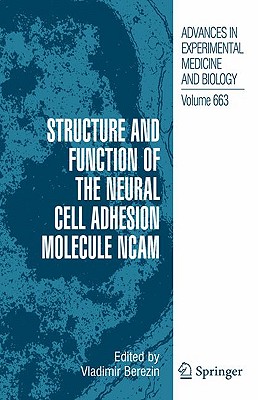
STRUCTURE & FUNCTION OF THE NE
Hardback · ISBN 9781441911698
Inclusive of GST and other taxes
Arriving at your doorstep in 10-15 days
Our logisitcs team will make sure everyitem is delivered safely
| ISBN | 9781441911698 |
|---|---|
| Subtitle | STRUCTURE & FUNCTION OF THE NE |
| Publisher | Springer |
| Publication date | December 2009 |
| Language | English |
| MRP | £179.99 GBP |
| Page count | 452 |
| Item weight | 178 g |
Dr. Elisabeth Bock (Photo Keenpress) This book contains review articles that produce a snapshot of recent developments in the field of the neural cell adhesion molecule NCAM. The chapters are grouped into sections reflecting various aspects of NCAM structure and function. The themes cover the structural basis of cell adhesion mediated by NCAM and NCAM interaction partners, NCAM-mediated signaling determinants of NCAM function under physiological conditions and in disease, and the therapeutic potential of NCAM mimetics. Section 1, "Structure and Ligands of NCAM," introduces the reader to the str- tural basis of NCAM-mediated cell adhesion, discussing the current knowledge of extracellular and intracellular NCAM ligands and the structural basis of NCAM int- actions with the fibroblast growth factor (FGF) receptor. Section 2, "NCAM and Polysialic Acid," focuses on NCAM polysialylation, discussing the structural and functional aspects of the most important posttranslational modifications of NCAM by the addition of a long linear homopolymer of sialic acid to the fifth Ig-like NCAM module. Section 3, "NCAM-mediated Signal Transduction," is devoted to signal v BookID 187530_ChapID FM1_Proof# 1 - 01/03/2011 BookID 187530_ChapID FM1_Proof# 1 - 01/03/2011 vi Preface transduction mechanisms associated with NCAM-mediated adhesion, with a focus on signaling pathways involved in NCAM-mediated neurite outgrowth, the role of growth-associated proteins, signaling through lipid microdomains, and signaling crosstalk with the epidermal growth factor (EGF) receptor. Section 4, "NCAM Metabolism," focuses on current knowledge about NCAM biosynthesis and the g- eration and role of soluble NCAM.
Log in to write a review for this book.
No reviews yet. Be the first to share your opinion.
Biography not available.