Bromme, Rainer Editor
Biography not available.

Browse all FOLKLORE books
Browse all GARDENS books
Browse all GRAPHIC NOVELS books
Browse all HISTORY - MEDIEVAL books
Browse all HUMOUR books
Browse all Juvenile Fiction : Biographical - Other books
Browse all Juvenile Fiction : Historical - Other books
Browse all Juvenile Fiction : Legends, Myths, & Fables - Other books
Browse all Juvenile Fiction : People & Places - Other books
Browse all Juvenile Fiction : People & Places - United States - Other books
Browse all Juvenile Fiction : Religious - Other books
Browse all Juvenile Nonfiction : History - Other books
Browse all Juvenile Nonfiction : Mathematics - Advanced books
Browse all Juvenile Nonfiction : People & Places - Other books
Browse all Juvenile Nonfiction : People & Places - United States - Othe books
Browse all LITERARY STUDIES books
Browse all LONDON books
Browse all Medical : Nursing - Mental Health books
Browse all MIND books
Browse all MUSEOLOGY books
Browse all NON-CLASSIFIABLE books
Browse all NONLINEAR SCIENCE books
Browse all POPULAR SCIENCE books
Browse all RELIGIOUS STUDIES books
Browse all SPIRIT books
Browse all SPORT books
Browse all TRAVEL WRITING books
 Out of Stock
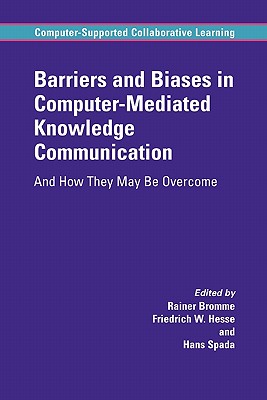
BARRIERS & BIASES IN COMPUTER-
Paperback · ISBN 9781441937209
Inclusive of GST and other taxes
Arriving at your doorstep in 10-15 days
Our logisitcs team will make sure everyitem is delivered safely
| ISBN | 9781441937209 |
|---|---|
| Subtitle | BARRIERS & BIASES IN COMPUTER- |
| Publisher | Springer |
| Publication date | December 2010 |
| Language | English |
| MRP | £173.00 GBP |
| Page count | 348 |
| Item weight | 108 g |
We report a study of one aspect of the changing industrial landscape, the use of virtual team working in the supply chain. The supply chain is the group of companies that are involved in the design and manufacture and distribution of products, notably complex products such as cars. Supply chain partnerships often involve cross-company team working, and as members of such teams are rarely collocated, virtual team working supported by IT, offers considerable potential benefits. Companies hope that these technologies can be used to support distributed computer supported collaborative working for purposes such as concurrent engineering and it is this kind of virtual teaming which we decided to investigate. We believe that exploring how virtual teams communicate is an effective way of examining how well they are operating and identifying the impacts of the technologies on their interactions. In the workplace free and open communication is considered to be very important to organizations facing a rapidly changing business environment. Similarly free and equal communication among members has been reported to be important if genuine team working is to be implemented in the workplace, (Carletta et al., 1998). If organizations are to derive benefits such as innovative problem solving from virtual team working then such open communication seems desirable. Communications technologies such as videoconferencing, shared applications etc. clearly offer the possibilities of such communications among geographically distributed or virtual teams.
Log in to write a review for this book.
No reviews yet. Be the first to share your opinion.
Biography not available.
Biography not available.
Biography not available.