Lootsma, Freerk A. Author
Biography not available.

Browse all FOLKLORE books
Browse all GARDENS books
Browse all GRAPHIC NOVELS books
Browse all HISTORY - MEDIEVAL books
Browse all HUMOUR books
Browse all Juvenile Fiction : Biographical - Other books
Browse all Juvenile Fiction : Historical - Other books
Browse all Juvenile Fiction : Legends, Myths, & Fables - Other books
Browse all Juvenile Fiction : People & Places - Other books
Browse all Juvenile Fiction : People & Places - United States - Other books
Browse all Juvenile Fiction : Religious - Other books
Browse all Juvenile Nonfiction : History - Other books
Browse all Juvenile Nonfiction : Mathematics - Advanced books
Browse all Juvenile Nonfiction : People & Places - Other books
Browse all Juvenile Nonfiction : People & Places - United States - Othe books
Browse all LITERARY STUDIES books
Browse all LONDON books
Browse all Medical : Nursing - Mental Health books
Browse all MIND books
Browse all MUSEOLOGY books
Browse all NON-CLASSIFIABLE books
Browse all NONLINEAR SCIENCE books
Browse all POPULAR SCIENCE books
Browse all RELIGIOUS STUDIES books
Browse all SPIRIT books
Browse all SPORT books
Browse all TRAVEL WRITING books
 Out of Stock
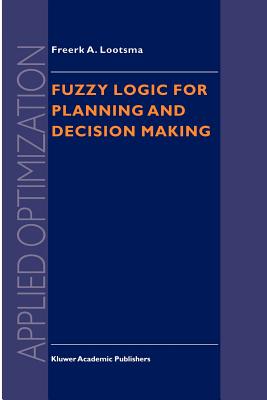
FUZZY LOGIC FOR PLANNING & DEC
Paperback · ISBN 9781441947796
Inclusive of GST and other taxes
Arriving at your doorstep in 10-15 days
Our logisitcs team will make sure everyitem is delivered safely
| ISBN | 9781441947796 |
|---|---|
| Subtitle | FUZZY LOGIC FOR PLANNING & DEC |
| Publisher | Springer |
| Publication date | December 2011 |
| Language | English |
| MRP | £89.99 GBP |
| Page count | 210 |
| Item weight | 67 g |
Thisvolume starts with the basicconceptsof FuzzyLogic: the membership function, the intersection and the union of fuzzy sets, fuzzy numbers, and the extension principle underlying the algorithmic operations. Several chapters are devoted to applications of FuzzyLogic in various branches of Operations Research: PERT planning with uncertain activity durations, SMART and the AHP for Multi-Criteria Decision Analysis (MCDA) with vague preferential statements, ELECTRE usingthe ideasof the AHP and SMART, and Multi-Objective Optimization (MOO) with weighted degrees of satisfaction. Finally, earlierstudiesof colour perception illustrate the attemptsto find a physiological basisfor the set-theoretical and the algorithmic operations in Fuzzy Logic. The last chapter also discusses somekey issues in linguistic categorization and the prospectsof FuzzyLogicas a multi-disciplinary research activity. I am greatly indebted to the Department of Mechanical Engineering and Applied Mechanics, College of Engineering, University of Michigan, Ann Arbor, for the splendid opportunity to start the actual work on this book during my sabbatical leavefrom Delft (1993 - 1994); to LAMSADE, Universite de Paris-Dauphine, where many ideas emerged duringtwo winter visits (1989, 1990); to the International Institute for Applied Systems Analysis, Laxenburg, Austria, whereI got further inspiration duringa number of summer visits (1992, 1995, and 1996); and to the NISSAN Foundation in The Netherlands who enabled me to visit several Japanese universities (June 1996). Moreover, I gratefully acknowledge the stimulating supportgiven by many colleagues inthe International Society on Multi-Criteria Decision Making and in the European Working Group "Aide Multicritere Ii la Decision".
Log in to write a review for this book.
No reviews yet. Be the first to share your opinion.
Biography not available.