Demengel, Françoise Author
Biography not available.

Browse all FOLKLORE books
Browse all GARDENS books
Browse all GRAPHIC NOVELS books
Browse all HISTORY - MEDIEVAL books
Browse all HUMOUR books
Browse all Juvenile Fiction : Biographical - Other books
Browse all Juvenile Fiction : Historical - Other books
Browse all Juvenile Fiction : Legends, Myths, & Fables - Other books
Browse all Juvenile Fiction : People & Places - Other books
Browse all Juvenile Fiction : People & Places - United States - Other books
Browse all Juvenile Fiction : Religious - Other books
Browse all Juvenile Nonfiction : History - Other books
Browse all Juvenile Nonfiction : Mathematics - Advanced books
Browse all Juvenile Nonfiction : People & Places - Other books
Browse all Juvenile Nonfiction : People & Places - United States - Othe books
Browse all LITERARY STUDIES books
Browse all LONDON books
Browse all Medical : Nursing - Mental Health books
Browse all MIND books
Browse all MUSEOLOGY books
Browse all NON-CLASSIFIABLE books
Browse all NONLINEAR SCIENCE books
Browse all POPULAR SCIENCE books
Browse all RELIGIOUS STUDIES books
Browse all SPIRIT books
Browse all SPORT books
Browse all TRAVEL WRITING books
 Out of Stock
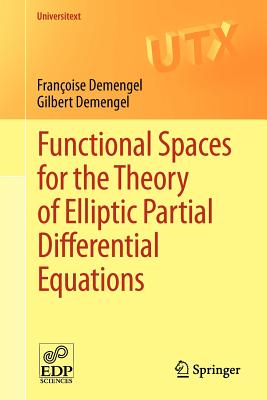
FUNCTIONAL SPACES FOR THE THEO
Paperback · ISBN 9781447128069
Inclusive of GST and other taxes
Arriving at your doorstep in 10-15 days
Our logisitcs team will make sure everyitem is delivered safely
| ISBN | 9781447128069 |
|---|---|
| Subtitle | FUNCTIONAL SPACES FOR THE THEO |
| Publisher | Springer |
| Publication date | January 2012 |
| Language | English |
| MRP | £59.99 GBP |
| Page count | 488 |
| Item weight | 150 g |
The theory of elliptic boundary problems is fundamental in analysis and the role of spaces of weakly differentiable functions (also called Sobolev spaces) is essential in this theory as a tool for analysing the regularity of the solutions.
This book offers on the one hand a complete theory of Sobolev spaces, which are of fundamental importance for elliptic linear and non-linear differential equations, and explains on the other hand how the abstract methods of convex analysis can be combined with this theory to produce existence results for the solutions of non-linear elliptic boundary problems. The book also considers other kinds of functional spaces which are useful for treating variational problems such as the minimal surface problem.
The main purpose of the book is to provide a tool for graduate and postgraduate students interested in partial differential equations, as well as a useful reference for researchers active in the field. Prerequisites include a knowledge of classical analysis, differential calculus, Banach and Hilbert spaces, integration and the related standard functional spaces, as well as the Fourier transformation on the Schwartz space.
There are complete and detailed proofs of almost all the results announced and, in some cases, more than one proof is provided in order to highlight different features of the result. Each chapter concludes with a range of exercises of varying levels of difficulty, with hints to solutions provided for many of them.
Log in to write a review for this book.
No reviews yet. Be the first to share your opinion.
Biography not available.
Biography not available.
Biography not available.