STREICHER THOMAS Author
Biography not available.

Browse all FOLKLORE books
Browse all GARDENS books
Browse all GRAPHIC NOVELS books
Browse all HISTORY - MEDIEVAL books
Browse all HUMOUR books
Browse all Juvenile Fiction : Biographical - Other books
Browse all Juvenile Fiction : Historical - Other books
Browse all Juvenile Fiction : Legends, Myths, & Fables - Other books
Browse all Juvenile Fiction : People & Places - Other books
Browse all Juvenile Fiction : People & Places - United States - Other books
Browse all Juvenile Fiction : Religious - Other books
Browse all Juvenile Nonfiction : History - Other books
Browse all Juvenile Nonfiction : Mathematics - Advanced books
Browse all Juvenile Nonfiction : People & Places - Other books
Browse all Juvenile Nonfiction : People & Places - United States - Othe books
Browse all LITERARY STUDIES books
Browse all LONDON books
Browse all Medical : Nursing - Mental Health books
Browse all MIND books
Browse all MUSEOLOGY books
Browse all NON-CLASSIFIABLE books
Browse all NONLINEAR SCIENCE books
Browse all POPULAR SCIENCE books
Browse all RELIGIOUS STUDIES books
Browse all SPIRIT books
Browse all SPORT books
Browse all TRAVEL WRITING books
 Out of Stock
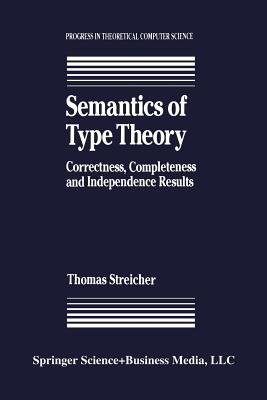
SEMANTICS OF TYPE THEORY SOFTC
Paperback · ISBN 9781461267577
Inclusive of GST and other taxes
Arriving at your doorstep in 10-15 days
Our logisitcs team will make sure everyitem is delivered safely
| ISBN | 9781461267577 |
|---|---|
| Subtitle | SEMANTICS OF TYPE THEORY SOFTC |
| Publisher | Birkhäuser |
| Publication date | October 2012 |
| Language | English |
| MRP | £74.99 GBP |
| Page count | 316 |
| Item weight | 98 g |
Typing plays an important role in software development. Types can be consid- ered as weak specifications of programs and checking that a program is of a certain type provides a verification that a program satisfies such a weak speci- fication. By translating a problem specification into a proposition in constructive logic, one can go one step further: the effectiveness and unifonnity of a con- structive proof allows us to extract a program from a proof of this proposition. Thus by the "proposition-as-types" paradigm one obtains types whose elements are considered as proofs. Each of these proofs contains a program correct w.r.t. the given problem specification. This opens the way for a coherent approach to the derivation of provably correct programs. These features have led to a "typeful" programming style where the classi- cal typing concepts such as records or (static) arrays are enhanced by polymor- phic and dependent types in such a way that the types themselves get a complex mathematical structure. Systems such as Coquand and Huet's Calculus of Con- structions are calculi for computing within extended type systems and provide a basis for a deduction oriented mathematical foundation of programming. On the other hand, the computational power and the expressive (impred- icativity !) of these systems makes it difficult to define appropriate semantics.
Log in to write a review for this book.
No reviews yet. Be the first to share your opinion.
Biography not available.