Mascarenhas, Angelo Editor
Biography not available.

Browse all FOLKLORE books
Browse all GARDENS books
Browse all GRAPHIC NOVELS books
Browse all HISTORY - MEDIEVAL books
Browse all HUMOUR books
Browse all Juvenile Fiction : Biographical - Other books
Browse all Juvenile Fiction : Historical - Other books
Browse all Juvenile Fiction : Legends, Myths, & Fables - Other books
Browse all Juvenile Fiction : People & Places - Other books
Browse all Juvenile Fiction : People & Places - United States - Other books
Browse all Juvenile Fiction : Religious - Other books
Browse all Juvenile Nonfiction : History - Other books
Browse all Juvenile Nonfiction : Mathematics - Advanced books
Browse all Juvenile Nonfiction : People & Places - Other books
Browse all Juvenile Nonfiction : People & Places - United States - Othe books
Browse all LITERARY STUDIES books
Browse all LONDON books
Browse all Medical : Nursing - Mental Health books
Browse all MIND books
Browse all MUSEOLOGY books
Browse all NON-CLASSIFIABLE books
Browse all NONLINEAR SCIENCE books
Browse all POPULAR SCIENCE books
Browse all RELIGIOUS STUDIES books
Browse all SPIRIT books
Browse all SPORT books
Browse all TRAVEL WRITING books
 Out of Stock
SPONTANEOUS ORDERING IN SEMICO
Paperback · ISBN 9781461351672
Inclusive of GST and other taxes
Arriving at your doorstep in 10-15 days
Our logisitcs team will make sure everyitem is delivered safely
| ISBN | 9781461351672 |
|---|---|
| Subtitle | SPONTANEOUS ORDERING IN SEMICO |
| Publisher | Springer |
| Publication date | November 2012 |
| Language | English |
| MRP | £44.99 GBP |
| Page count | 500 |
| Item weight | 190 g |
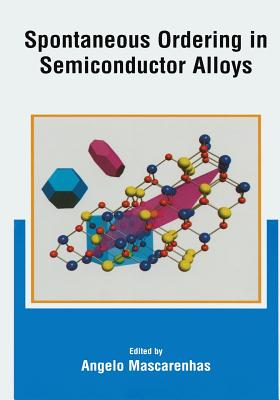
The phenomenonofspontaneous ordering in semiconductoralloys, which can be categorized as a self-organized process, is observed to occur sponta- neously during epitaxial growth of certain ternary alloy semiconductors and results in a modification of their structural, electronic, and optical properties. There has been a great dealofinterest in learning how to control this phenome- non so that it may be used for tailoring desirable electronic and optical properties. There has been even greater interest in exploiting the phenomenon for its unique ability in providing an experimental environment of controlled alloy statistical fluctuations. As such, itimpacts areasofsemiconductorscience and technology related to the materials science ofepitaxial growth, statistical mechanics, and electronic structure of alloys and electronic and photonic devices. During the past two decades, significant progress has been made toward understanding the mechanisms that drive this phenomenon and the changes in physical properties that result from it. A variety of experimental techniques have been used to probe the phenomenon and several attempts made atproviding theoretical models both for the ordering mechanisms as well as electronic structure changes. The various chapters of this book provide a detailed account of these efforts during the past decade. The first chapter provides an elaborate account of the phenomenon, with an excellent perspective of the structural and elec- tronic modifications itinduces.
Log in to write a review for this book.
No reviews yet. Be the first to share your opinion.
Biography not available.