Melandri, Bruno Andrea Editor
Biography not available.

Browse all FOLKLORE books
Browse all GARDENS books
Browse all GRAPHIC NOVELS books
Browse all HISTORY - MEDIEVAL books
Browse all HUMOUR books
Browse all Juvenile Fiction : Biographical - Other books
Browse all Juvenile Fiction : Historical - Other books
Browse all Juvenile Fiction : Legends, Myths, & Fables - Other books
Browse all Juvenile Fiction : People & Places - Other books
Browse all Juvenile Fiction : People & Places - United States - Other books
Browse all Juvenile Fiction : Religious - Other books
Browse all Juvenile Nonfiction : History - Other books
Browse all Juvenile Nonfiction : Mathematics - Advanced books
Browse all Juvenile Nonfiction : People & Places - Other books
Browse all Juvenile Nonfiction : People & Places - United States - Othe books
Browse all LITERARY STUDIES books
Browse all LONDON books
Browse all Medical : Nursing - Mental Health books
Browse all MIND books
Browse all MUSEOLOGY books
Browse all NON-CLASSIFIABLE books
Browse all NONLINEAR SCIENCE books
Browse all POPULAR SCIENCE books
Browse all RELIGIOUS STUDIES books
Browse all SPIRIT books
Browse all SPORT books
Browse all TRAVEL WRITING books
 Out of Stock
BIOELECTROCHEMISTRY IV SOFTCOV
Paperback · ISBN 9781461361015
Inclusive of GST and other taxes
Arriving at your doorstep in 10-15 days
Our logisitcs team will make sure everyitem is delivered safely
| ISBN | 9781461361015 |
|---|---|
| Subtitle | BIOELECTROCHEMISTRY IV SOFTCOV |
| Publisher | Springer |
| Publication date | November 2012 |
| Language | English |
| MRP | £44.99 GBP |
| Page count | 392 |
| Item weight | 150 g |
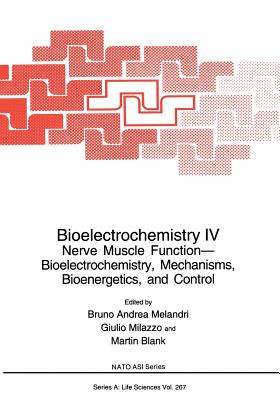
by G. MILAZZO and M. BLANK This book contains the lectures of the fourth advanced course Bioelectrochemislry W Neroe-Muscle Function: Bioelectrochemistry, Mechanisms, Energetics and Contro which took place at the Majorana Center in Erice, Italy, October 20th to November 1, 1991. The scope of the course was international in terms of both sponsorship and partici- pation. Sponsors included the Bioelectrochemical Society, NATO, International Union of Pure and Applied Biophysics (lUPAB), the World Federation of Scientists and the Italian National Research Council. One-third of the sixty participants were from Italy, but the majority came from eighteen other nations. Since the course was part of the International School of Biophysics, the biophysi- cal point of view was emphasized in integrating the biology with the electrochemistry. Lecturers were asked to use a quantitative approach with accepted standards and proper units, since this is absolutely essential for developing an effective common language for communication across disciplines. Participants were also urged not to forget that biological systems could also be considered as physical systems. Ion channels are proteins and their properties as polyelectrolytes contribute to the specific biological properties. The existence of families of channels, with very similar structures but different selectivities, suggests that the specificities arise from slight variations of a general basic design. These perspectives on nerve-muscle function helped to make the school course a unique treatment of the subject.
Log in to write a review for this book.
No reviews yet. Be the first to share your opinion.
Biography not available.
Biography not available.
Biography not available.