Stampi Author
Biography not available.

Browse all FOLKLORE books
Browse all GARDENS books
Browse all GRAPHIC NOVELS books
Browse all HISTORY - MEDIEVAL books
Browse all HUMOUR books
Browse all Juvenile Fiction : Biographical - Other books
Browse all Juvenile Fiction : Historical - Other books
Browse all Juvenile Fiction : Legends, Myths, & Fables - Other books
Browse all Juvenile Fiction : People & Places - Other books
Browse all Juvenile Fiction : People & Places - United States - Other books
Browse all Juvenile Fiction : Religious - Other books
Browse all Juvenile Nonfiction : History - Other books
Browse all Juvenile Nonfiction : Mathematics - Advanced books
Browse all Juvenile Nonfiction : People & Places - Other books
Browse all Juvenile Nonfiction : People & Places - United States - Othe books
Browse all LITERARY STUDIES books
Browse all LONDON books
Browse all Medical : Nursing - Mental Health books
Browse all MIND books
Browse all MUSEOLOGY books
Browse all NON-CLASSIFIABLE books
Browse all NONLINEAR SCIENCE books
Browse all POPULAR SCIENCE books
Browse all RELIGIOUS STUDIES books
Browse all SPIRIT books
Browse all SPORT books
Browse all TRAVEL WRITING books
 Out of Stock
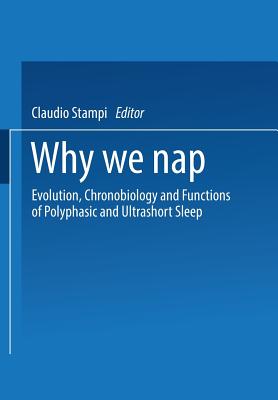
WHY WE NAP 1992/E
Paperback · ISBN 9781475722123
Inclusive of GST and other taxes
Arriving at your doorstep in 10-15 days
Our logisitcs team will make sure everyitem is delivered safely
| ISBN | 9781475722123 |
|---|---|
| Subtitle | WHY WE NAP 1992/E |
| Publisher | Birkhäuser |
| Publication date | November 2013 |
| Language | English |
| MRP | £74.99 GBP |
| Page count | 308 |
| Item weight | 109 g |
J ÜRGEN AscHOFF "Very bad habit! Very bad habit!" Captain Giles to Joseph Conrad who had taken a siesta. -Conrad: The Shadow Line On the Multiplicity of Rest-Activity Cycles: Some Historical and Conceptual Notes According to its title this book tries to answer the profound question of why we nap-and why Captain Giles was wrong in blaming Conrad for having napped. However, in this volume the term nap is not used in the narrower sense of an afternoon siesta; instead, emphasis is placed on the recurrent alternation between states of alertness and drowsiness, i. e., on rest-activity cycles of high er frequency throughout the 24 hr. In view of this focus, two authors (Stampi, in Chapter I, and Ball, in Chapter 3) rightly refer to the psychologist Szymanski who was among the first to describe "polyphasic" activity patterns. Hence, I consider it appropriate to open this foreword with a few historical remarks. At the time when Szymanski (1920) made the distinction between "monophasic" and "polyphasic" rest-activity patterns and sleep-wake cy- cles, respectively, not much was known about the mechanisms of such temporal structures. Although the botanists quite some time ago had demonstrated the endogenous nature of the "monophasic" sleep movements in plants, the hypothesis of an (still unknown) external driving force was favored by those who studied rhythms in animals and humans (Aschoff, 1990).
Log in to write a review for this book.
No reviews yet. Be the first to share your opinion.