Yaroslavskii, Leonid Author
Biography not available.

Browse all FOLKLORE books
Browse all GARDENS books
Browse all GRAPHIC NOVELS books
Browse all HISTORY - MEDIEVAL books
Browse all HUMOUR books
Browse all Juvenile Fiction : Biographical - Other books
Browse all Juvenile Fiction : Historical - Other books
Browse all Juvenile Fiction : Legends, Myths, & Fables - Other books
Browse all Juvenile Fiction : People & Places - Other books
Browse all Juvenile Fiction : People & Places - United States - Other books
Browse all Juvenile Fiction : Religious - Other books
Browse all Juvenile Nonfiction : History - Other books
Browse all Juvenile Nonfiction : Mathematics - Advanced books
Browse all Juvenile Nonfiction : People & Places - Other books
Browse all Juvenile Nonfiction : People & Places - United States - Othe books
Browse all LITERARY STUDIES books
Browse all LONDON books
Browse all Medical : Nursing - Mental Health books
Browse all MIND books
Browse all MUSEOLOGY books
Browse all NON-CLASSIFIABLE books
Browse all NONLINEAR SCIENCE books
Browse all POPULAR SCIENCE books
Browse all RELIGIOUS STUDIES books
Browse all SPIRIT books
Browse all SPORT books
Browse all TRAVEL WRITING books
 Out of Stock
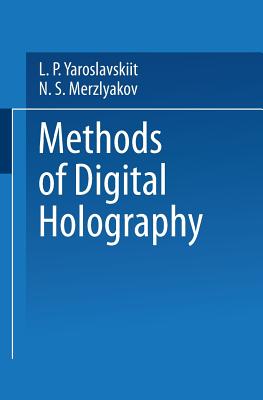
METHODS OF DIGITAL HOLOGRAPHY
Paperback · ISBN 9781475758290
Inclusive of GST and other taxes
Arriving at your doorstep in 10-15 days
Our logisitcs team will make sure everyitem is delivered safely
| ISBN | 9781475758290 |
|---|---|
| Subtitle | METHODS OF DIGITAL HOLOGRAPHY |
| Publisher | Springer |
| Publication date | October 2013 |
| Language | English |
| MRP | £44.99 GBP |
| Page count | 184 |
| Item weight | 44 g |
Digital holography is the analysis and synthesis of wavefronts by means of digital computers. Here "analysis" means the construction of images of objects and the measurement of their physical characteristics by recording and measur- ing the wavefronts scattered by these objects. The "synthesis" is the reconstruc- tion of a wavefront of an object which is specified numerically. Problems involving the analysis and synthesis of wave fronts arise frequently in modem science and engineering. These are the problems encountered in the use of electromagnetic and sound waves to peer into the interior of various objects, the problems of the visual display of information in general, and the problems of measuring the characteristics of radiating systems, devising optical apparatus for signal processing, and developing hybrid electrooptic computer systems. Solutions are being sought for these problems through research in holography. The use of digital computers to analyze and synthesize wavefronts is an alternative to the analog methods, which include the methods of physical holography. The digital approach potentially has the advantages which are inherent in the digital technique for signal processing: the processing is highly accurate and absolutely reproducible; the characteristics of the processing or the processing algorithm itself can be changed in a simple way; complicated nonlinear and logic conversions can be carried out; the results are accessible; and it is easy to modify the process at any stage. Digital methods are particularly suitable where quantitative results are required.
Log in to write a review for this book.
No reviews yet. Be the first to share your opinion.
Biography not available.