Eysenck, Michael Editor
Biography not available.

Browse all FOLKLORE books
Browse all GARDENS books
Browse all GRAPHIC NOVELS books
Browse all HISTORY - MEDIEVAL books
Browse all HUMOUR books
Browse all Juvenile Fiction : Biographical - Other books
Browse all Juvenile Fiction : Historical - Other books
Browse all Juvenile Fiction : Legends, Myths, & Fables - Other books
Browse all Juvenile Fiction : People & Places - Other books
Browse all Juvenile Fiction : People & Places - United States - Other books
Browse all Juvenile Fiction : Religious - Other books
Browse all Juvenile Nonfiction : History - Other books
Browse all Juvenile Nonfiction : Mathematics - Advanced books
Browse all Juvenile Nonfiction : People & Places - Other books
Browse all Juvenile Nonfiction : People & Places - United States - Othe books
Browse all LITERARY STUDIES books
Browse all LONDON books
Browse all Medical : Nursing - Mental Health books
Browse all MIND books
Browse all MUSEOLOGY books
Browse all NON-CLASSIFIABLE books
Browse all NONLINEAR SCIENCE books
Browse all POPULAR SCIENCE books
Browse all RELIGIOUS STUDIES books
Browse all SPIRIT books
Browse all SPORT books
Browse all TRAVEL WRITING books
 Out of Stock
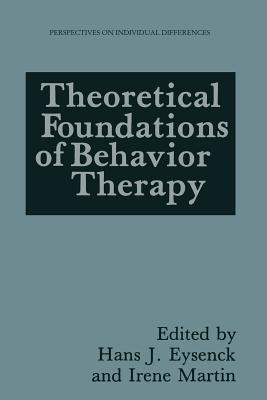
THEORETICAL FOUNDATIONS OF BEH
Paperback · ISBN 9781489908292
Inclusive of GST and other taxes
Arriving at your doorstep in 10-15 days
Our logisitcs team will make sure everyitem is delivered safely
| ISBN | 9781489908292 |
|---|---|
| Subtitle | THEORETICAL FOUNDATIONS OF BEH |
| Publisher | Springer |
| Publication date | June 2013 |
| Language | English |
| MRP | £129.99 GBP |
| Page count | 496 |
| Item weight | 152 g |
In this book we have attempted to confront a number of issues that are intimately related to the theoretical basis of behavior therapy. We believe that behavior therapy is an extremely efficient procedure for the treatment of neurotic disorders; that it is based on certain principles derived from learning theory; and that it is unique in using basic scientific principles in psychology in the service of applied and practical ends. We believe that we are here dealing with much more than the advantageous use of serendipitous borrowings from nonexistent principles, the cookbook collection of precepts, methods, and working rules that happen to have lasting effects. We also believe that there is truly a general principle unde. rlying behavior therapy, rather than a varied mass of nonintegrated therapies that have little in common other than a name. These beliefs are often contes ted, but usually those who oppose them do so on the basis of misconceptions and misunderstandings that indicate a lack of knowledge of fundamental facts. It is the purpose of this book to remove these misconceptions and misunderstandings, and to bring up to date our knowledge in certain fundamental areas of learning theory, behavior therapy, and the biological foundations of per- sonality and individual differences. There are three major groups of misconceptions and misunderstandings. The first of these relates to beliefs held by many psychiatrists and cognitive psychologists relating to behavior therapy.
Log in to write a review for this book.
No reviews yet. Be the first to share your opinion.
Biography not available.
Biography not available.