Morrison, John Douglas Author
Biography not available.

Browse all FOLKLORE books
Browse all GARDENS books
Browse all GRAPHIC NOVELS books
Browse all HISTORY - MEDIEVAL books
Browse all HUMOUR books
Browse all Juvenile Fiction : Biographical - Other books
Browse all Juvenile Fiction : Historical - Other books
Browse all Juvenile Fiction : Legends, Myths, & Fables - Other books
Browse all Juvenile Fiction : People & Places - Other books
Browse all Juvenile Fiction : People & Places - United States - Other books
Browse all Juvenile Fiction : Religious - Other books
Browse all Juvenile Nonfiction : History - Other books
Browse all Juvenile Nonfiction : Mathematics - Advanced books
Browse all Juvenile Nonfiction : People & Places - Other books
Browse all Juvenile Nonfiction : People & Places - United States - Othe books
Browse all LITERARY STUDIES books
Browse all LONDON books
Browse all Medical : Nursing - Mental Health books
Browse all MIND books
Browse all MUSEOLOGY books
Browse all NON-CLASSIFIABLE books
Browse all NONLINEAR SCIENCE books
Browse all POPULAR SCIENCE books
Browse all RELIGIOUS STUDIES books
Browse all SPIRIT books
Browse all SPORT books
Browse all TRAVEL WRITING books
 Out of Stock
Hardback · ISBN 9781498248037
Inclusive of GST and other taxes
Arriving at your doorstep in 10-15 days
Our logisitcs team will make sure everyitem is delivered safely
| ISBN | 9781498248037 |
|---|---|
| Publisher | Pickwick Publications |
| Publication date | March 2006 |
| Language | English |
| MRP | £52.00 GBP |
| Page count | 322 |
| Item weight | 132 g |
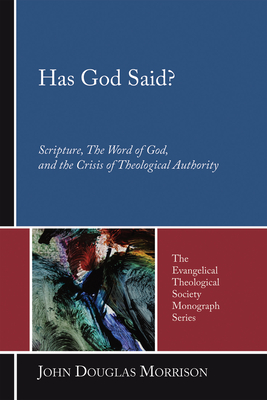
Has God said? Has God actually spoken, declared himself and his purposes to us? Historically the Christian faith has affirmed God's redemptive, revelatory speaking as historical, contentful, redemptive, centrally in Jesus Christ and, under Christ and by the Spirit, in the text of Holy Scripture. But in the past three centuries developments in Western culture have created a crisis in relation to historical, divine authority. The modern reintroduction of destructive dualisms, cosmological and epistemological, via Descartes, Newton, Spinoza, and Kant have injured not only the physical sciences (e.g., positivism) but Christian theology as well. The resulting "eclipse of God" has permeated Western culture. In terms of the Christian understanding of revelation, it has meant the separation of God from historical action, the rejection of God's actual self-declaration, and especially in textual form, Holy Scripture. After critical analysis of these dualistic developments, this book presents the problematic effects in both Protestant (Schleiermacher, Bultmann, Tillich) and Roman Catholic (Rahner, Dulles) theology. The thought and influence of Karl Barth on the nature of Scripture is examined and distinguished from most "Barthian approaches." The effects of dualistic "Barthian" thought on contemporary evangelical views of Scripture (Pinnock, Fackre, Bloesch) are also critically analyzed and responses made (Helm, Wolterstorff, Packer). The final chapter is a christocentric, multileveled reformulation of the classical Scripture Principle, via Einstein, Torrance, and Calvin, that reaffirms the church's historical "identity thesis," that Holy Scripture is the written Word of God, a crucial aspect of God's larger redemptive-revelatory purpose in Christ.
Log in to write a review for this book.
No reviews yet. Be the first to share your opinion.
Biography not available.