Rosenbloom, David H. Editor
Biography not available.

Browse all FOLKLORE books
Browse all GARDENS books
Browse all GRAPHIC NOVELS books
Browse all HISTORY - MEDIEVAL books
Browse all HUMOUR books
Browse all Juvenile Fiction : Biographical - Other books
Browse all Juvenile Fiction : Historical - Other books
Browse all Juvenile Fiction : Legends, Myths, & Fables - Other books
Browse all Juvenile Fiction : People & Places - Other books
Browse all Juvenile Fiction : People & Places - United States - Other books
Browse all Juvenile Fiction : Religious - Other books
Browse all Juvenile Nonfiction : History - Other books
Browse all Juvenile Nonfiction : Mathematics - Advanced books
Browse all Juvenile Nonfiction : People & Places - Other books
Browse all Juvenile Nonfiction : People & Places - United States - Othe books
Browse all LITERARY STUDIES books
Browse all LONDON books
Browse all Medical : Nursing - Mental Health books
Browse all MIND books
Browse all MUSEOLOGY books
Browse all NON-CLASSIFIABLE books
Browse all NONLINEAR SCIENCE books
Browse all POPULAR SCIENCE books
Browse all RELIGIOUS STUDIES books
Browse all SPIRIT books
Browse all SPORT books
Browse all TRAVEL WRITING books
 Out of Stock
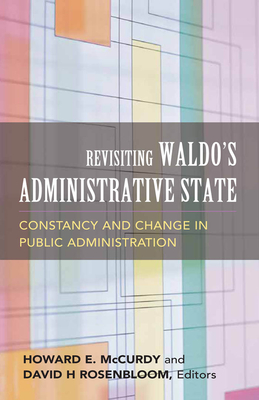
REVISITING WALDOS ADMINISTRATI
Paperback · ISBN 9781589010932
Inclusive of GST and other taxes
Arriving at your doorstep in 10-15 days
Our logisitcs team will make sure everyitem is delivered safely
| ISBN | 9781589010932 |
|---|---|
| Subtitle | REVISITING WALDOS ADMINISTRATI |
| Publisher | Georgetown University Press |
| Language | English |
| MRP | £26.50 GBP |
| Page count | 248 |
| Item weight | 82 g |
The prevailing notion that the best government is achieved through principles of management and business practices is hardly new--it echoes the early twentieth-century "gospel of efficiency" challenged by Dwight Waldo in 1948 in his pathbreaking book, The Administrative State. Asking, "Efficiency for what?", Waldo warned that public administrative efficiency must be backed by a framework of consciously held democratic values.
Revisiting Waldo's Administrative State brings together a group of distinguished authors who critically explore public administration's big ideas and issues and question whether contemporary efforts to "reinvent government," promote privatization, and develop new public management approaches constitute a coherent political theory capable of meeting the complex challenges of governing in a democracy. Taking Waldo's book as a starting point, the authors revisit and update his key concepts and consider their applicability for today.
The book follows Waldo's conceptual structure, first probing the material and ideological background of modern public administration, problems of political philosophy, and finally particular challenges inherent in contemporary administrative reform. It concludes with a look ahead to "wicked" policy problems--such as terrorism, global warming, and ecological threats--whose scope is so global and complex that they will defy any existing administrative structures and values. Calling for a return to conscious consideration of democratic accountability, fairness, justice, and transparency in government, the book's conclusion assesses the future direction of public administrative thought.
This book can stand alone as a commentary on reconciling democratic values and governance today or as a companion when reading Waldo's classic volume.
Log in to write a review for this book.
No reviews yet. Be the first to share your opinion.
Biography not available.
Biography not available.
Biography not available.