Fuyarchuk, Andrew Author
Biography not available.

Browse all FOLKLORE books
Browse all GARDENS books
Browse all GRAPHIC NOVELS books
Browse all HISTORY - MEDIEVAL books
Browse all HUMOUR books
Browse all Juvenile Fiction : Biographical - Other books
Browse all Juvenile Fiction : Historical - Other books
Browse all Juvenile Fiction : Legends, Myths, & Fables - Other books
Browse all Juvenile Fiction : People & Places - Other books
Browse all Juvenile Fiction : People & Places - United States - Other books
Browse all Juvenile Fiction : Religious - Other books
Browse all Juvenile Nonfiction : History - Other books
Browse all Juvenile Nonfiction : Mathematics - Advanced books
Browse all Juvenile Nonfiction : People & Places - Other books
Browse all Juvenile Nonfiction : People & Places - United States - Othe books
Browse all LITERARY STUDIES books
Browse all LONDON books
Browse all Medical : Nursing - Mental Health books
Browse all MIND books
Browse all MUSEOLOGY books
Browse all NON-CLASSIFIABLE books
Browse all NONLINEAR SCIENCE books
Browse all POPULAR SCIENCE books
Browse all RELIGIOUS STUDIES books
Browse all SPIRIT books
Browse all SPORT books
Browse all TRAVEL WRITING books
 Out of Stock
Paperback · ISBN 9781606087725
Inclusive of GST and other taxes
Arriving at your doorstep in 10-15 days
Our logisitcs team will make sure everyitem is delivered safely
| ISBN | 9781606087725 |
|---|---|
| Publisher | Wipf and Stock |
| Publication date | March 2010 |
| Language | English |
| MRP | £24.00 GBP |
| Page count | 224 |
| Item weight | 68 g |
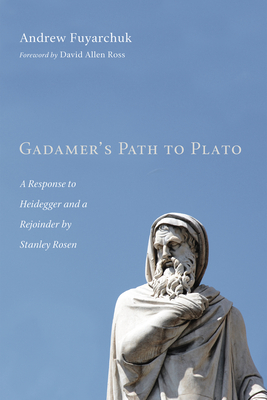
Gadamer's Path to Plato investigates the formative years of Hans-Georg Gadamer's Plato studies, while studying with Martin Heidegger at Marburg University. It outlines the evolution of Heidegger's understanding of Plato, explains why his hermeneutics and phenomenological method inspired Gadamer, and why Heidegger's argument, that Plato was responsible for Western civilization's forgetting the meaning of existence, provoked him. Heidegger's provocation was crucial to the development of Gadamer's understanding of Plato. This book thus puts forward an argument for Gadamer's having indirectly refuted Heidegger's Plato. This involves a dialogical relationship to the past and a re-examination of the relation of Plato to Aristotle in matters of ethics, physics, and truth. Above all, however, it is Gadamer's concept of Platonic dialectic that refutes Heidegger. This challenge to Heidegger's Plato was commensurate with the origination of Gadamer's positive hermeneutical philosophy. In order to test the alleged openness of that philosophy to the other as other Gadamer's reading of the Republic is scrutinized by using the brilliant scholarship of Stanley Rosen. An examination of their interpretations of the Republic includes an inquiry into their intellectual influences. For Gadamer these include Hegel, the Tubingen school and Jacob Klein; for Rosen, the poetic genius of Leo Strauss. Rosen's mathematical and poetic orientation is then compared to Gadamer's dialectical orientation to Plato. The mathematical approach dovetails with a theory of human nature and procedural rationalism in Gadamer's hermeneutical philosophy that explains why he, in contrast to Rosen, bypasses important dimensions of the Republic such as the significance of particular characters and settings to understanding the whole. In turn, this methodological shortcoming calls into question the truth of Gadamer's method and, with it, the foundations of a truly open and pluralist society.
Log in to write a review for this book.
No reviews yet. Be the first to share your opinion.
Biography not available.
Biography not available.