Abes, Elisa S. Editor
Biography not available.

Browse all FOLKLORE books
Browse all GARDENS books
Browse all GRAPHIC NOVELS books
Browse all HISTORY - MEDIEVAL books
Browse all HUMOUR books
Browse all Juvenile Fiction : Biographical - Other books
Browse all Juvenile Fiction : Historical - Other books
Browse all Juvenile Fiction : Legends, Myths, & Fables - Other books
Browse all Juvenile Fiction : People & Places - Other books
Browse all Juvenile Fiction : People & Places - United States - Other books
Browse all Juvenile Fiction : Religious - Other books
Browse all Juvenile Nonfiction : History - Other books
Browse all Juvenile Nonfiction : Mathematics - Advanced books
Browse all Juvenile Nonfiction : People & Places - Other books
Browse all Juvenile Nonfiction : People & Places - United States - Othe books
Browse all LITERARY STUDIES books
Browse all LONDON books
Browse all Medical : Nursing - Mental Health books
Browse all MIND books
Browse all MUSEOLOGY books
Browse all NON-CLASSIFIABLE books
Browse all NONLINEAR SCIENCE books
Browse all POPULAR SCIENCE books
Browse all RELIGIOUS STUDIES books
Browse all SPIRIT books
Browse all SPORT books
Browse all TRAVEL WRITING books
 Out of Stock
Hardback · ISBN 9781620367636
Inclusive of GST and other taxes
Arriving at your doorstep in 10-15 days
Our logisitcs team will make sure everyitem is delivered safely
| ISBN | 9781620367636 |
|---|---|
| Publisher | Routledge |
| Publication date | July 2019 |
| Language | English |
| MRP | £171.99 GBP |
| Page count | 298 |
| Item weight | 125 g |
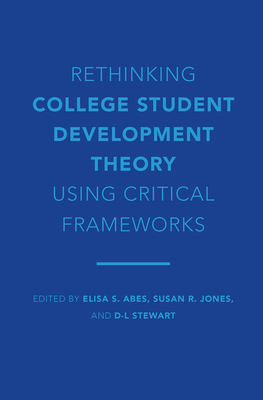
A major new contribution to college student development theory, this book brings "third wave" theories to bear on this vitally important topic.
The first section includes a chapter that provides an overview of the evolution of student development theories as well as chapters describing the critical and poststructural theories most relevant to the next iteration of student development theory. These theories include critical race theory, queer theory, feminist theories, intersectionality, decolonizing/indigenous theories, and crip theories. These chapters also include a discussion of how each theory is relevant to the central questions of student development theory.
The second section provides critical interpretations of the primary constructs associated with student development theory. These constructs and their related ideas include resilience, dissonance, socially constructed identities, authenticity, agency, context, development (consistency/coherence/stability), and knowledge (sources of truth and belief systems). Each chapter begins with brief personal narratives on a particular construct; the chapter authors then re-envision the narrative's highlighted construct using one or more critical theories.
The third section will focus on implications for practice. Specifically, these chapters will consider possibilities for how student development constructs re-envisioned through critical perspectives can be utilized in practice.
The primary audience for the book is faculty members who teach in graduate programs in higher education and student affairs and their students. The book will also be useful to practitioners seeking guidance in working effectively with students across the convergence of multiple aspects of identity and development.
Log in to write a review for this book.
No reviews yet. Be the first to share your opinion.
Biography not available.
Biography not available.
Biography not available.