Plescia, Carolina Author
Biography not available.

Browse all FOLKLORE books
Browse all GARDENS books
Browse all GRAPHIC NOVELS books
Browse all HISTORY - MEDIEVAL books
Browse all HUMOUR books
Browse all Juvenile Fiction : Biographical - Other books
Browse all Juvenile Fiction : Historical - Other books
Browse all Juvenile Fiction : Legends, Myths, & Fables - Other books
Browse all Juvenile Fiction : People & Places - Other books
Browse all Juvenile Fiction : People & Places - United States - Other books
Browse all Juvenile Fiction : Religious - Other books
Browse all Juvenile Nonfiction : History - Other books
Browse all Juvenile Nonfiction : Mathematics - Advanced books
Browse all Juvenile Nonfiction : People & Places - Other books
Browse all Juvenile Nonfiction : People & Places - United States - Othe books
Browse all LITERARY STUDIES books
Browse all LONDON books
Browse all Medical : Nursing - Mental Health books
Browse all MIND books
Browse all MUSEOLOGY books
Browse all NON-CLASSIFIABLE books
Browse all NONLINEAR SCIENCE books
Browse all POPULAR SCIENCE books
Browse all RELIGIOUS STUDIES books
Browse all SPIRIT books
Browse all SPORT books
Browse all TRAVEL WRITING books
 Out of Stock
Hardback · ISBN 9781785521805
Inclusive of GST and other taxes
Arriving at your doorstep in 10-15 days
Our logisitcs team will make sure everyitem is delivered safely
| ISBN | 9781785521805 |
|---|---|
| Publisher | ECPR Press |
| Publication date | May 2016 |
| Language | English |
| MRP | £72.00 GBP |
| Page count | 172 |
| Item weight | 93 g |
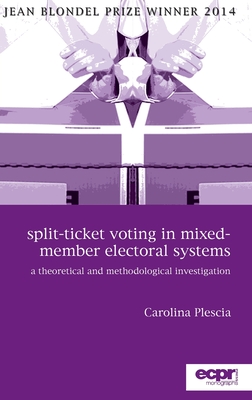
Why do voters support different parties at elections when given the opportunity of casting two votes to elect the same representative body? This book relaxes common assumptions in the voting behaviour literature to provide an in-depth study of split-ticket voting across ten established and non-established democracies. It proposes an original framework and combines a theoretical investigation with a purely methodological analysis to test the reliability of the predictive models. The broader picture that emerges is the one of a 'simple' voter with 'sophisticated' preferences. Parties still function as the principal cue for voting, but voters appear sophisticated in that they often like more than one party or choose candidates regardless of their party affiliation. Despite mixed-member systems being one of the most complicated electoral systems of all, there is no evidence supporting the conclusion that voters are not able to cope with the complexity of the electoral rules.
Log in to write a review for this book.
No reviews yet. Be the first to share your opinion.
Biography not available.