Kaye, Lawrence J. Author
Biography not available.

Browse all FOLKLORE books
Browse all GARDENS books
Browse all GRAPHIC NOVELS books
Browse all HISTORY - MEDIEVAL books
Browse all HUMOUR books
Browse all Juvenile Fiction : Biographical - Other books
Browse all Juvenile Fiction : Historical - Other books
Browse all Juvenile Fiction : Legends, Myths, & Fables - Other books
Browse all Juvenile Fiction : People & Places - Other books
Browse all Juvenile Fiction : People & Places - United States - Other books
Browse all Juvenile Fiction : Religious - Other books
Browse all Juvenile Nonfiction : History - Other books
Browse all Juvenile Nonfiction : Mathematics - Advanced books
Browse all Juvenile Nonfiction : People & Places - Other books
Browse all Juvenile Nonfiction : People & Places - United States - Othe books
Browse all LITERARY STUDIES books
Browse all LONDON books
Browse all Medical : Nursing - Mental Health books
Browse all MIND books
Browse all MUSEOLOGY books
Browse all NON-CLASSIFIABLE books
Browse all NONLINEAR SCIENCE books
Browse all POPULAR SCIENCE books
Browse all RELIGIOUS STUDIES books
Browse all SPIRIT books
Browse all SPORT books
Browse all TRAVEL WRITING books
 Out of Stock
Hardback · ISBN 9781793651556
Inclusive of GST and other taxes
Arriving at your doorstep in 10-15 days
Our logisitcs team will make sure everyitem is delivered safely
| ISBN | 9781793651556 |
|---|---|
| Publisher | Lexington Books |
| Publication date | October 2023 |
| Language | English |
| MRP | £75.00 GBP |
| Page count | 176 |
| Item weight | 95 g |
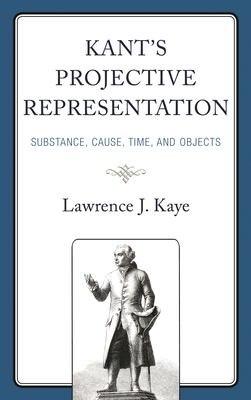
Kant's Projective Representation: Substance, Cause, Time, and Objects is a textually thorough study of Kant's account of mental representation that yields a new understanding of the primary doctrines of the Critique of Pure Reason. Lawrence J. Kaye argues that in the Transcendental Deduction, the analytic unity of concepts establishes the necessary unity of consciousness, which also constitutes representation. In the First Analogy, Kant argues that our ability to represent sequences, simultaneity, and durations rests on the conceptually prior representation of persistence. Without persistence in empirical perceptions, we must represent persistence with identities across intuitions that project an external world of persistent matter. The other Analogies explain how we represent sequences through necessitated state transitions in objects and how we represent simultaneity through mutual influence. These pure unifications that constitute representation are the schematized (relational) categories--instances of the same types of unifying functions that underlie the concepts of substance, causation, and community. We know a priori that all perceptual experiences will project a world with this structure, which is synthetic a priori metaphysical knowledge. This interpretation also shows how Kant reconciles realism and idealism: we empirically represent a world that is external to consciousness, but we do so by using unities that are purely mental constructions.
Log in to write a review for this book.
No reviews yet. Be the first to share your opinion.
Biography not available.