Osborne, Martin, J. Author
Biography not available.

Browse all FOLKLORE books
Browse all GARDENS books
Browse all GRAPHIC NOVELS books
Browse all HISTORY - MEDIEVAL books
Browse all HUMOUR books
Browse all Juvenile Fiction : Biographical - Other books
Browse all Juvenile Fiction : Historical - Other books
Browse all Juvenile Fiction : Legends, Myths, & Fables - Other books
Browse all Juvenile Fiction : People & Places - Other books
Browse all Juvenile Fiction : People & Places - United States - Other books
Browse all Juvenile Fiction : Religious - Other books
Browse all Juvenile Nonfiction : History - Other books
Browse all Juvenile Nonfiction : Mathematics - Advanced books
Browse all Juvenile Nonfiction : People & Places - Other books
Browse all Juvenile Nonfiction : People & Places - United States - Othe books
Browse all LITERARY STUDIES books
Browse all LONDON books
Browse all Medical : Nursing - Mental Health books
Browse all MIND books
Browse all MUSEOLOGY books
Browse all NON-CLASSIFIABLE books
Browse all NONLINEAR SCIENCE books
Browse all POPULAR SCIENCE books
Browse all RELIGIOUS STUDIES books
Browse all SPIRIT books
Browse all SPORT books
Browse all TRAVEL WRITING books
 Out of Stock
Hardback · ISBN 9781805111252
Inclusive of GST and other taxes
Arriving at your doorstep in 10-15 days
Our logisitcs team will make sure everyitem is delivered safely
| ISBN | 9781805111252 |
|---|---|
| Publisher | Open Book Publishers |
| Publication date | June 2023 |
| Language | English |
| MRP | £52.95 GBP |
| Page count | 380 |
| Item weight | 278 g |
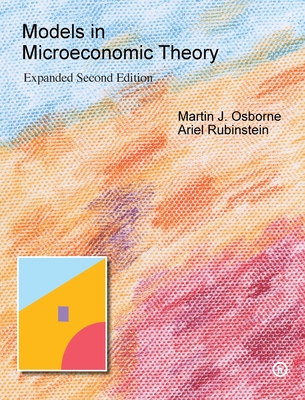
Models in Microeconomic Theory covers basic models in current microeconomic theory. Part I (Chapters 1-7) presents models of an economic agent, discussing abstract models of preferences, choice, and decision making under uncertainty, before turning to models of the consumer, the producer, and monopoly. Part II (Chapters 8-14) introduces the concept of equilibrium, beginning, unconventionally, with the models of the jungle and an economy with indivisible goods, and continuing with models of an exchange economy, equilibrium with rational expectations, and an economy with asymmetric information. Part III (Chapters 15-16) provides an introduction to game theory, covering strategic and extensive games and the concepts of Nash equilibrium and subgame perfect equilibrium. Part IV (Chapters 17-20) gives a taste of the topics of mechanism design, matching, the axiomatic analysis of economic systems, and social choice.
The book focuses on the concepts of model and equilibrium. It states models and results precisely, and provides proofs for all results. It uses only elementary mathematics (with almost no calculus), although many of the proofs involve sustained logical arguments. It includes about 150 exercises.
With its formal but accessible style, this textbook is designed for undergraduate students of microeconomics at intermediate and advanced levels.
Log in to write a review for this book.
No reviews yet. Be the first to share your opinion.
Biography not available.
Biography not available.