Grant, John Editor
Biography not available.

Browse all FOLKLORE books
Browse all GARDENS books
Browse all GRAPHIC NOVELS books
Browse all HISTORY - MEDIEVAL books
Browse all HUMOUR books
Browse all Juvenile Fiction : Biographical - Other books
Browse all Juvenile Fiction : Historical - Other books
Browse all Juvenile Fiction : Legends, Myths, & Fables - Other books
Browse all Juvenile Fiction : People & Places - Other books
Browse all Juvenile Fiction : People & Places - United States - Other books
Browse all Juvenile Fiction : Religious - Other books
Browse all Juvenile Nonfiction : History - Other books
Browse all Juvenile Nonfiction : Mathematics - Advanced books
Browse all Juvenile Nonfiction : People & Places - Other books
Browse all Juvenile Nonfiction : People & Places - United States - Othe books
Browse all LITERARY STUDIES books
Browse all LONDON books
Browse all Medical : Nursing - Mental Health books
Browse all MIND books
Browse all MUSEOLOGY books
Browse all NON-CLASSIFIABLE books
Browse all NONLINEAR SCIENCE books
Browse all POPULAR SCIENCE books
Browse all RELIGIOUS STUDIES books
Browse all SPIRIT books
Browse all SPORT books
Browse all TRAVEL WRITING books
 Out of Stock
Paperback · ISBN 9781848902442
Inclusive of GST and other taxes
Arriving at your doorstep in 5-7 days
Our logisitcs team will make sure everyitem is delivered safely
| ISBN | 9781848902442 |
|---|---|
| Publisher | College Publications |
| Publication date | February 2018 |
| Language | English |
| MRP | £18.00 GBP |
| Page count | 364 |
| Item weight | 113 g |
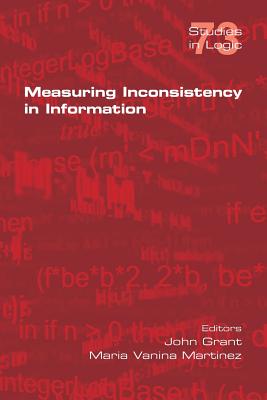
The concept of measuring inconsistency in information was developed by John Grant in a 1978 paper in the context of first-order logic. For more than 20 years very little was done in this area until in the early 2000s a number of AI researchers started to formulate new inconsistency measures primarily in the context of propositional logic knowledge bases. The aim of this volume is to survey what has been done so far, to expand inconsistency measurement to other formalisms, to connect it with related topics, and to provide ideas for further research in a topic that is particularly relevant now in view of the many inconsistencies in the massive amount of information available.
The book contains 11 chapters. The first chapter, by John Grant, gives his original motivation for starting this field, explains why it was formulated in a highly mathematical manner, presents important material that was omitted from the original paper, and provides ideas about the use of dimensions in measuring inconsistency. The second chapter, by Matthias Thimm, is a survey that covers most of the research on inconsistency measures up to 2017. The other 9 chapters, all by experts either in inconsistency measures, or in the topic under consideration, or both, connect inconsistency measures with argumentation, disjunctive logic programming, fuzzy logic systems, modal logics, multiset representation, paraconsistent consequence, probabilistic logic, relational databases, and spatio-temporal databases.
Log in to write a review for this book.
No reviews yet. Be the first to share your opinion.
Biography not available.
Biography not available.