Willis, Nicholas J, Author
Biography not available.

Browse all FOLKLORE books
Browse all GARDENS books
Browse all GRAPHIC NOVELS books
Browse all HISTORY - MEDIEVAL books
Browse all HUMOUR books
Browse all Juvenile Fiction : Biographical - Other books
Browse all Juvenile Fiction : Historical - Other books
Browse all Juvenile Fiction : Legends, Myths, & Fables - Other books
Browse all Juvenile Fiction : People & Places - Other books
Browse all Juvenile Fiction : People & Places - United States - Other books
Browse all Juvenile Fiction : Religious - Other books
Browse all Juvenile Nonfiction : History - Other books
Browse all Juvenile Nonfiction : Mathematics - Advanced books
Browse all Juvenile Nonfiction : People & Places - Other books
Browse all Juvenile Nonfiction : People & Places - United States - Othe books
Browse all LITERARY STUDIES books
Browse all LONDON books
Browse all Medical : Nursing - Mental Health books
Browse all MIND books
Browse all MUSEOLOGY books
Browse all NON-CLASSIFIABLE books
Browse all NONLINEAR SCIENCE books
Browse all POPULAR SCIENCE books
Browse all RELIGIOUS STUDIES books
Browse all SPIRIT books
Browse all SPORT books
Browse all TRAVEL WRITING books
 Out of Stock
Hardback · ISBN 9781891121487
Inclusive of GST and other taxes
Arriving at your doorstep in 10-15 days
Our logisitcs team will make sure everyitem is delivered safely
| ISBN | 9781891121487 |
|---|---|
| Publisher | Institute of Electrical Engineers |
| Publication date | June 2007 |
| Language | English |
| MRP | £125.00 GBP |
| Page count | 516 |
| Item weight | 244 g |
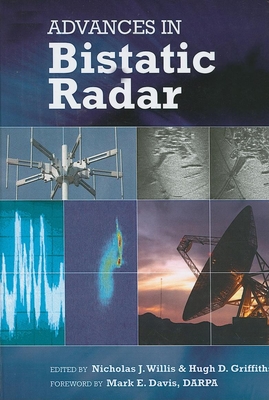
Advances in Bistatic Radar updates and extends bistatic and multistatic radar developments since the publication of Willis' Bistatic Radar in 1991. New and recently declassified military applications are documented, civil applications are detailed including commercial and scientific systems and leading radar engineers provide expertise to each of these applications. Advances in Bistatic Radar consists of two major sections: Bistatic/Multistatic Radar Systems and Bistatic Clutter and Signal Processing. Starting with a history update, the first section documents the early and now declassified military AN/FPS-23 Fluttar DEW-Line Gap-filler, and high frequency (HF) bistatic radars developed for missile attack warning. It then documents the recently developed passive bistatic and multistatic radars exploiting commercial broadcast transmitters for military and civilian air surveillance. Next, the section documents scientific bistatic radar systems for planetary exploration, which have exploited data link transmitters over the last forty years; ionospheric measurements, again exploiting commercial broadcast transmitters; and 3-D wind field measurements using a bistatic receiver hitchhiking off doppler weather radars. This last application has been commercialized. The second section starts by documenting the full, unclassified bistatic clutter scattering coefficient data base, along with the theory and analysis supporting its development. The section then details two major clutter-related developments, spotlight bistatic synthetic aperture radar (SAR), which can now generate high resolution images using bistatic autofocus and related techniques; and adaptive moving target indication (MTI), which allows cancellation of nonstationary clutter generated by moving (i.e. airborne) platforms through the use of bistatic space-time adaptive processing (STAP).
Log in to write a review for this book.
No reviews yet. Be the first to share your opinion.
Biography not available.
Biography not available.
Biography not available.