Rondanini, Luigi Pascal Author
Biography not available.

Browse all FOLKLORE books
Browse all GARDENS books
Browse all GRAPHIC NOVELS books
Browse all HISTORY - MEDIEVAL books
Browse all HUMOUR books
Browse all Juvenile Fiction : Biographical - Other books
Browse all Juvenile Fiction : Historical - Other books
Browse all Juvenile Fiction : Legends, Myths, & Fables - Other books
Browse all Juvenile Fiction : People & Places - Other books
Browse all Juvenile Fiction : People & Places - United States - Other books
Browse all Juvenile Fiction : Religious - Other books
Browse all Juvenile Nonfiction : History - Other books
Browse all Juvenile Nonfiction : Mathematics - Advanced books
Browse all Juvenile Nonfiction : People & Places - Other books
Browse all Juvenile Nonfiction : People & Places - United States - Othe books
Browse all LITERARY STUDIES books
Browse all LONDON books
Browse all Medical : Nursing - Mental Health books
Browse all MIND books
Browse all MUSEOLOGY books
Browse all NON-CLASSIFIABLE books
Browse all NONLINEAR SCIENCE books
Browse all POPULAR SCIENCE books
Browse all RELIGIOUS STUDIES books
Browse all SPIRIT books
Browse all SPORT books
Browse all TRAVEL WRITING books
 Out of Stock
Paperback · ISBN 9781918177091
Inclusive of GST and other taxes
Arriving at your doorstep in 10-15 days
Our logisitcs team will make sure everyitem is delivered safely
| ISBN | 9781918177091 |
|---|---|
| Publisher | Rondanini Publishing Ltd |
| Publication date | May 2026 |
| Language | English |
| MRP | £11.99 GBP |
| Page count | 84 |
| Item weight | 21 g |
What if every poem you've ever read was only telling you half the story?
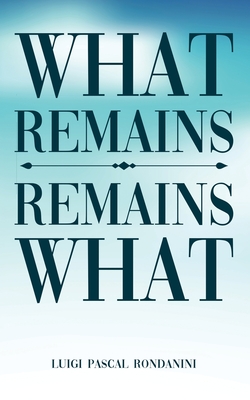
What Remains / Remains What is a collection of twenty-seven bidirectional poems - works that transform completely when read from bottom to top. A poem about despair becomes one about hope. A meditation on betrayal reverses into gratitude. An elegy for a closed factory rebuilds a community. The words never change. Only the direction does. Only you do.
Spanning five thematic movements - love and its reversals, self and shadow, time's arrow, the world and its weight, and the uncertain territory between endings and beginnings - these poems confront separation, grief, complicity, inheritance, and the quiet violence we inflict on ourselves. Three interludes allow the form to laugh at itself without losing its nerve, taking aim at self-help culture, therapy-speak, and the promise of digital enlightenment.
Each poem was composed as a single act of attention, descending line by line into its subject, then tested by the return journey. Many did not survive. What remains are the poems that proved themselves true in both directions - not because the words changed, but because the reader does.
This is not a gimmick. It is a lens. It reveals that despair and hope are not opposites but perspectives - two ways of reading the same evidence. Some reversals offer consolation. Others deepen the wound. Some expose what we would rather not see.
Read each poem downward first. Then read it upward. Notice what shifts. That shift is the poem's real subject.
For readers of Raymond Carver's economy, Warsan Shire's emotional precision, and anyone who has ever suspected that the story they were told could be read another way.
Log in to write a review for this book.
No reviews yet. Be the first to share your opinion.
Biography not available.