Edgar Goodaire G Author
Biography not available.

Browse all ART CRITICISM books
Browse all Ashworth books
Browse all FOLKLORE books
Browse all GARDENS books
Browse all GRAPHIC NOVELS books
Browse all Hamilton books
Browse all HISTORY - MEDIEVAL books
Browse all HUMOUR books
Browse all KINDRED books
Browse all LITERARY STUDIES books
Browse all LONDON books
Browse all Lozada books
Browse all Medical : Nursing - Mental Health books
Browse all MIND books
Browse all MUSEOLOGY books
Browse all NON-CLASSIFIABLE books
Browse all NONLINEAR SCIENCE books
Browse all Ormonde books
Browse all POPULAR SCIENCE books
Browse all RELIGIOUS STUDIES books
Browse all SPIRIT books
Browse all SPORT books
Browse all TRAVEL WRITING books
 Out of Stock
Paperback · ISBN 9781944659912
Inclusive of GST and other taxes
Arriving at your doorstep in 2-3 days
Our logisitcs team will make sure everyitem is delivered safely
| ISBN | 9781944659912 |
|---|---|
| Publisher | World Scientific |
| Language | English |
| Page count | 732 |
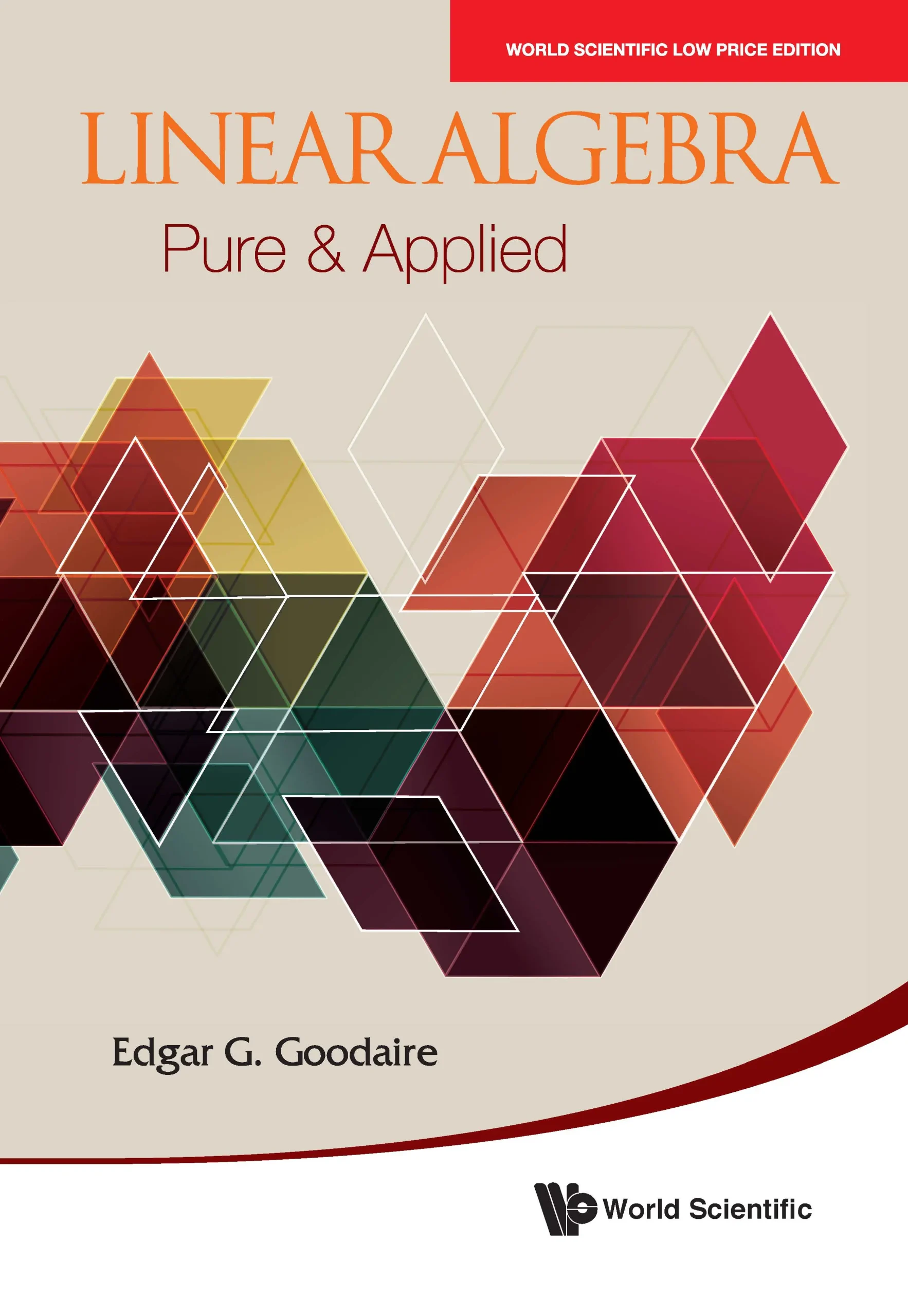
This is a matrix-oriented approach to linear algebra that covers the traditional material of the courses generally known as “Linear Algebra I” and “Linear Algebra II” throughout North America, but it also includes more advanced topics such as the pseudoinverse and the singular value decomposition that make it appropriate for a more advanced course as well. As is becoming increasingly the norm, the book begins with the geometry of Euclidean 3-space so that important concepts like linear combination, linear independence and span can be introduced early and in a “real” context. The book reflects the author’s background as a pure mathematician — all the major definitions and theorems of basic linear algebra are covered rigorously — but the restriction of vector spaces to Euclidean n-space and linear transformations to matrices, for the most part, and the continual emphasis on the system Ax=b, make the book less abstract and more attractive to the students of today than some others. As the subtitle suggests, however, applications play an important role too. Coding theory and least squares are recurring themes. Other applications include electric circuits, Markov chains, quadratic forms and conic sections, facial recognition and computer graphics.
Log in to write a review for this book.
No reviews yet. Be the first to share your opinion.
Biography not available.