Verichev, Nikolai Author
Biography not available.

Browse all FOLKLORE books
Browse all GARDENS books
Browse all GRAPHIC NOVELS books
Browse all HISTORY - MEDIEVAL books
Browse all HUMOUR books
Browse all Juvenile Fiction : Biographical - Other books
Browse all Juvenile Fiction : Historical - Other books
Browse all Juvenile Fiction : Legends, Myths, & Fables - Other books
Browse all Juvenile Fiction : People & Places - Other books
Browse all Juvenile Fiction : People & Places - United States - Other books
Browse all Juvenile Fiction : Religious - Other books
Browse all Juvenile Nonfiction : History - Other books
Browse all Juvenile Nonfiction : Mathematics - Advanced books
Browse all Juvenile Nonfiction : People & Places - Other books
Browse all Juvenile Nonfiction : People & Places - United States - Othe books
Browse all LITERARY STUDIES books
Browse all LONDON books
Browse all Medical : Nursing - Mental Health books
Browse all MIND books
Browse all MUSEOLOGY books
Browse all NON-CLASSIFIABLE books
Browse all NONLINEAR SCIENCE books
Browse all POPULAR SCIENCE books
Browse all RELIGIOUS STUDIES books
Browse all SPIRIT books
Browse all SPORT books
Browse all TRAVEL WRITING books
 Out of Stock
Hardback · ISBN 9783030361020
Inclusive of GST and other taxes
Arriving at your doorstep in 10-15 days
Our logisitcs team will make sure everyitem is delivered safely
| ISBN | 9783030361020 |
|---|---|
| Publisher | Springer |
| Publication date | January 2020 |
| Language | English |
| MRP | £89.99 GBP |
| Page count | 212 |
| Item weight | 105 g |
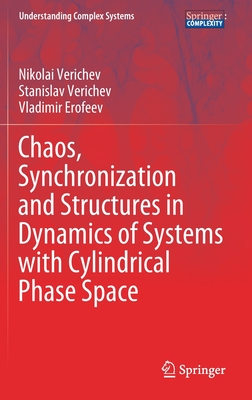
This book develops analytical methods for studying the dynamical chaos, synchronization, and dynamics of structures in various models of coupled rotators.
Rotators and their systems are defined in a cylindrical phase space, and, unlike oscillators, which are defined in Rn, they have a wider "range" of motion: There are vibrational and rotational types for cyclic variables, as well as their combinations (rotational-vibrational) if the number of cyclic variables is more than one. The specificity of rotator phase space poses serious challenges in terms of selecting methods for studying the dynamics of related systems.
The book chiefly focuses on developing a modified form of the method of averaging, which can be used to study the dynamics of rotators. In general, the book uses the "language" of the qualitative theory of differential equations, point mappings, and the theory of bifurcations, which helps authors to obtain new results on dynamical chaos in systemswith few degrees of freedom. In addition, a special section is devoted to the study and classification of dynamic structures that can occur in systems with a large number of interconnected objects, i.e. in lattices of rotators and/or oscillators.
Given its scope and format, the book can be used both in lectures and courses on nonlinear dynamics, and in specialized courses on the development and operation of relevant systems that can be represented by a large number of various practical systems: interconnected grids of various mechanical systems, various types of networks including not only mechanical but also biological systems, etc.
Log in to write a review for this book.
No reviews yet. Be the first to share your opinion.
Biography not available.
Biography not available.
Biography not available.