Broitman, Jessica Author
Biography not available.

Browse all FOLKLORE books
Browse all GARDENS books
Browse all GRAPHIC NOVELS books
Browse all HISTORY - MEDIEVAL books
Browse all HUMOUR books
Browse all Juvenile Fiction : Biographical - Other books
Browse all Juvenile Fiction : Historical - Other books
Browse all Juvenile Fiction : Legends, Myths, & Fables - Other books
Browse all Juvenile Fiction : People & Places - Other books
Browse all Juvenile Fiction : People & Places - United States - Other books
Browse all Juvenile Fiction : Religious - Other books
Browse all Juvenile Nonfiction : History - Other books
Browse all Juvenile Nonfiction : Mathematics - Advanced books
Browse all Juvenile Nonfiction : People & Places - Other books
Browse all Juvenile Nonfiction : People & Places - United States - Othe books
Browse all LITERARY STUDIES books
Browse all LONDON books
Browse all Medical : Nursing - Mental Health books
Browse all MIND books
Browse all MUSEOLOGY books
Browse all NON-CLASSIFIABLE books
Browse all NONLINEAR SCIENCE books
Browse all POPULAR SCIENCE books
Browse all RELIGIOUS STUDIES books
Browse all SPIRIT books
Browse all SPORT books
Browse all TRAVEL WRITING books
 Out of Stock
Hardback · ISBN 9783030561079
Inclusive of GST and other taxes
Arriving at your doorstep in 10-15 days
Our logisitcs team will make sure everyitem is delivered safely
| ISBN | 9783030561079 |
|---|---|
| Publisher | Springer |
| Publication date | October 2020 |
| Language | English |
| MRP | £109.99 GBP |
| Page count | 226 |
| Item weight | 109 g |
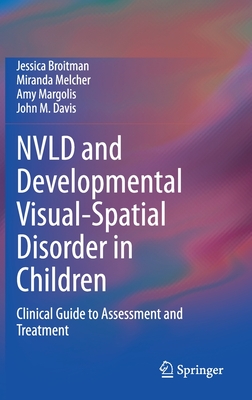
This unique volume explores issues related to working with children who have nonverbal learning disability (NVLD). It examines how a child's psychology - thoughts, feelings, beliefs - affects his or her functioning and learning. In addition, the book addresses how a child's experiences are processed through individual personality, psychology, culture, environment and economic circumstances, and family dynamics. Using these psychological organizing principles, the book describes how to work most effectively with young patients with NVLD. It offers a new model and definition for understanding NVLD, emphasizing its core deficit of visual-spatial processing.
In addition, this book addresses efforts to rename NVLD to developmental visual-spatial disorder (DVSD). It describes the 11 possible subtypes as including a primary deficit in visual-spatial processes and impairment in several additional functional domains, including executive functioning, social/emotional deficits, academic achievement, and motor coordination. The book highlights the need for psychologically minded treatment and provides specific intervention guidelines. It details how to conduct the intake process and create a treatment plan and team and offers practical suggestions for working with a patient's family members. In addition, the book addresses the importance of working with a consistent psychological theory, such as control mastery theory (CMT). It describes the Brooklyn Learning Center Model for treating NVLD and offers guidelines for interventions to support patients academically. The book provides a comprehensive approach to the neuropsychological assessment of NVLD as well as examples of visual-spatial, sensory perception, executive functioning, academics, social/emotional deficits and motor coordination interventions, and all forms used to gather information from patients.
Key areas of coverage include:
NVLD and Developmental Visual-Spatial Disorder in Children is an essential reference for clinicians, therapists, and other professionals as well as researchers, professors, and graduate students in school and clinical child psychology, special education, speech-language therapy, developmental psychology, pediatrics, social work as well as all interrelated disciplines.
Log in to write a review for this book.
No reviews yet. Be the first to share your opinion.
Biography not available.
Biography not available.
Biography not available.