Garg, Muskan Editor
Biography not available.

Browse all FOLKLORE books
Browse all GARDENS books
Browse all GRAPHIC NOVELS books
Browse all HISTORY - MEDIEVAL books
Browse all HUMOUR books
Browse all Juvenile Fiction : Biographical - Other books
Browse all Juvenile Fiction : Historical - Other books
Browse all Juvenile Fiction : Legends, Myths, & Fables - Other books
Browse all Juvenile Fiction : People & Places - Other books
Browse all Juvenile Fiction : People & Places - United States - Other books
Browse all Juvenile Fiction : Religious - Other books
Browse all Juvenile Nonfiction : History - Other books
Browse all Juvenile Nonfiction : Mathematics - Advanced books
Browse all Juvenile Nonfiction : People & Places - Other books
Browse all Juvenile Nonfiction : People & Places - United States - Othe books
Browse all LITERARY STUDIES books
Browse all LONDON books
Browse all Medical : Nursing - Mental Health books
Browse all MIND books
Browse all MUSEOLOGY books
Browse all NON-CLASSIFIABLE books
Browse all NONLINEAR SCIENCE books
Browse all POPULAR SCIENCE books
Browse all RELIGIOUS STUDIES books
Browse all SPIRIT books
Browse all SPORT books
Browse all TRAVEL WRITING books
 Out of Stock
Hardback · ISBN 9783031638206
Inclusive of GST and other taxes
Arriving at your doorstep in 10-15 days
Our logisitcs team will make sure everyitem is delivered safely
| ISBN | 9783031638206 |
|---|---|
| Publisher | Springer |
| Publication date | November 2024 |
| Language | English |
| MRP | £179.99 GBP |
| Page count | 284 |
| Item weight | 127 g |
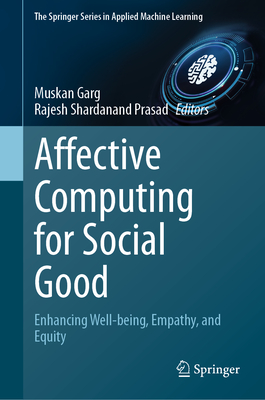
Affective Computing for Social Good: Enhancing Well-being, Empathy, and Equity offers an insightful journey into the intricate realm of affective computing. It covers a spectrum of topics ranging from foundational theories and technologies to ethical considerations and future possibilities.
Beginning with "Deciphering the Emotional Spectrum: Advances in Emotion Science and Analysis," it sets the stage by tracing the evolution of understanding human emotions. Subsequent chapters explore practical applications, such as integrating clinical psychology with affective computing for therapeutic progress and leveraging affective computing in diagnosing and managing mood disorders more efficiently.
As the narrative unfolds, the book emphasizes the crucial role of affective computing in fostering social justice and equity. It underscores the need for developing inclusive algorithms and databases while addressing ethical challenges like privacy, consent, and the risk of emotional manipulation. These discussions emphasize the significance of ethical deployment and regulation.
The book also covers the technical aspects and applications of affective computing, including natural language processing for emotion recognition and analysis, voice emotion detection, and visual emotion recognition. It extends to applications, such as the use of affective computing in health management via recommender systems and personalized well-being interventions in mental health care.
Addressing data challenges, "Enhancing Affective Computing with Data Augmentation: Strategies for Overcoming Limited Data Availability" presents solutions for imbalances affecting model performance. "Advancements in Multimodal Emotion Recognition" highlights the integration of facial expressions with physiological signals to improve emotion recognition accuracy and reliability.
Concluding with "Ethical Considerations in Affective Computing" and "Cognitive Currents: A Path from Neuroscience to Consciousness," the book connects technical advancements in affective computing with broader ethical and philosophical inquiries surrounding consciousness and the human experience.
Features:
Overall, this book will help readers gain a deeper understanding of the intersection between AI and human emotions, and how this technology can be used to create a more empathetic, compassionate, and socially responsible world.
Log in to write a review for this book.
No reviews yet. Be the first to share your opinion.
Biography not available.
Biography not available.